Dance, Drums and Tradition – Wings Summer 2025

A collage of people wearing traditional clothing


The steady beat of drums reverberated across the Heritage University campus on Saturday, April 19, as hundreds gathered to honor Native American culture at the annual All Nations Student Social Powwow.

The free event, hosted by the Heritage University Native American Club (HUNAC) and sponsored by the Johnson Scholarship Foundation, drew dancers, drum groups, families and vendors from throughout the region for a day of vibrant cultural expression. Traditional, fancy, jingle and grass dance styles filled the arena, with performers ranging in age from toddlers to elders.

“This has really become an annual tradition — a time when we share our culture with the broader campus and local community,” said Anany Scott, HUNAC president and lead organizer. “The support we’ve received this year has been incredible, and the turnout speaks volumes about how this event continues to grow.”

A person wearing a colorful headdressOne of the day’s most poignant moments came with a tribute dance honoring Missing and Murdered Indigenous Women, a solemn and powerful reminder of the injustices facing Native communities nationwide.

Beyond the dancing, children in attendance were treated to a festive Easter egg hunt, adding a family-friendly element to the day’s programming.

Now in its fifth year, the powwow has become a cornerstone event for the university and the surrounding community, drawing families year over year. Organizers confirmed that planning is already underway for next year’s celebration.Heritage Eagle

From Nursing Student to Nursing Chair – Wings Summer 2025

FROM NURSING STUDENT TO NURSING CHAIR

Heritage’s new Gaye and Jim Pigott Endowed Chair of Nursing knows the student experience at the university better than most. After all, she was part of the second cohort in the Bachelor of Nursing program when it started 10 years ago. Now, she brings a passion for educating more nurses from underserved populations and improving healthcare for rural communities in the Yakima Valley.

Two people treating a patientThe new chair of Heritage University’s nursing department, Shelby Clark, Doctor of Nursing Practice (DNP) — is home, exactly where she wants to be.

Home is the Yakima Valley. Home is the Yakama Reservation. Home is Heritage University. It is where she knows she can make the most significant difference in the health and lives of marginalized communities.

Clark is an enrolled member of the Yakama Nation and the first Native American graduate of Heritage’s Bachelor of Nursing program. In high school, she dreamed of being a helicopter pilot and, later, a flight nurse in the military. She’d travel, have adventures, and save lives.

Today, Clark is in a life-changing — and life-saving — adventure of another kind; she’s leading a program making its mark on the face of healthcare in rural central Washington. Instead of impacting one person at a time, she is multiplying that impact by training nurses who will return to their home communities to provide care.

Her work heading Heritage’s nursing program focuses on recruiting and training students from more underserved populations — primarily Native American and Latinx. What she is most excited about is the possibility that many of them will stay in the Yakima Valley and care for the underserved communities in the region.

A person smiling at the cameraGROWING UP-SEEING THE NEED

Clark grew up in the small town of White Swan. Its population is just under 600; most residents are either Native American (67%) or Hispanic (14%). The poverty rate is nearly double that of nearby Yakima and three times the overall average in Washington state. Additionally, there are limited medical services in the immediate area. Indian Health Services operates a medical clinic staffed by a physician assistant and an emergency ambulance service.

The combination of low incomes and limited health services contributes to a community health crisis that is hard to miss. Growing up, Clark saw people struggle with a litany of chronic, serious, and often life-threatening health issues. This hasn’t changed much since she was young.

In her community, Clark’s family was better off than most. She was young when her mother and father pursued their education. Ultimately, her father became an electrician and her mother a teacher. Some of her other family members also achieved professional success: Her grandmother and two aunts were nurses, and other family members served in the military.

These relatives inspired her. In high school, Clark decided to join the military and become a critical care flight nurse. After graduating, she set her plan in motion and enrolled at Yakima Valley College for her first two years of study, and she started looking for schools to earn her bachelor’s degree. She applied to various programs, including Heritage. Dr. Christina Nyirati was the chair of the program then. She invited Clark to visit campus and talk about the program.

“Dr. Nyirati always tells me she remembers me walking into her office clearly stating I was going to be an ICU flight nurse,” Clark said. “I was determined — but something else was meant to be.”

Nyirati described the nursing program, its goals, and how it was established to create nurses for the community and provide meaningful help for the Yakama Reservation and the Yakima Valley patient populations.

“You would literally be fulfilling our mission,” Nyirati told Clark.

Clark knew she had found her place.

“People at Heritage looked like me,” Clark said. “I knew it was where I belonged.”

As part of her education, Clark did rotations in women’s health and public health, both at Indian Health Services (IHS) — the Department of Health and Human Services (HHS) agency that provides health services to Native Americans. Public health focuses on disease prevention, promoting health, and protecting the health of populations through organized societal efforts.

Clark was familiar with IHS and the care they provided. It was where her family had always gone for their health care. Working at the clinic in patient care gave her a new appreciation for their service and the importance of training more Native American and Hispanic nurses.

As a nursing student, Clark experienced greater trust and welcome from patients than some of her counterparts, “because I looked like them, I talked like them, some of them knew my family,” she said.

She explained that the historical mistreatment of Native Americans has built deeply rooted mistrust of those from outside of the culture in members of her community.

“There’s a lack of ability to trust caregivers when you feel misplaced.”

That, she said, can be a significant barrier to healthcare.

Seeing how she was able to connect to patients and the impact she made in the short time she worked at IHS changed her direction. She set aside her plan to work as a flight nurse and focused on public health.

FROM THE UNIVERSITY OF WASHINGTON BACK TO HERITAGE

As Clark neared graduation, she researched graduate programs for her next step, ultimately landing on the University of Washington Doctor of Nursing Practice (DNP) program, ranked number one in the country.

She started the UW’s program in the fall after earning her bachelor’s degree. There, she was trained to look at, discover, and identify problems within populations that could be part of improving outcomes through program planning and evaluation. The focus aligned perfectly with her goal of returning home to the Valley and doing work that would directly improve the health and lives of people on the reservation.

Clark graduated with her Doctor of Nursing Practice (DPN) in Population Health & Systems Leadership in 2022. She applied to various jobs and kept in touch with Nyirati, who ultimately offered her the Nursing Student Success Retention Specialist position at Heritage. In that position, Clark worked closely with nursing students, especially as they prepared for their state license exam.

“I had thought that perhaps my next role would have been with one of our tribal health systems or that I would work for the State

Department of Health,” said Clark. “I ended up loving working with Heritage students. I never intended to enter academia, but I decided this was where I could have the biggest impact.”

A group of women in blue shirts doing a medical exam

WHAT MATTERS IN NURSING: CONNECTION

Nursing professionals need to listen to patients and, when working with Native and Hispanic people, to understand their communication style, circumstances, and history, Clark said.

“From the time of triage and admission to a hospital unit and ultimately discharge, nurses spend so much time with patients. We are usually their most trusted advocates. We can get to the root of many of their issues, so we have the potential to provide the most meaningful help.

“But we must meet them where they are, and for Native and Hispanic people, having care providers who are like them and understand them is critical. Because I am a brown person, I am more welcomed in their space than others.”

Clark explains that this familiarity impacts care when the patient is in the clinic and extends into their homes and lifestyle choices. Nurses can come up against some challenges when it comes to empowering people to take an active role in their healthcare.

“That requires a mindset that begins in childhood and includes a lot of public education and recognition of the importance of self-advocacy — as well as that comfort level with their health care providers.

“We need nurses who look like the people in our community, and we need nurses who understand that because we are rural and unique, our patients think about and approach problems differently. We can have a big impact on many people, like at what point in a health-related situation they decide to seek care, and what can happen after discharge that can improve outcomes.”

HERITAGE’S IMPACT

While Heritage is helping to make a difference, change takes time. Nine people were part of the first nursing cohort to graduate seven years ago. This year, there were 17 graduates. More than 100 nurses earned their B.S.N. from Heritage, most of whom were Latinx.

Clark has taken on a personal challenge to grow these numbers even higher, especially when recruiting and training Native American nurses as part of the cohort.

“Ultimately, I want better health outcomes for all communities. We can make great strides, but more is needed, especially in Native communities. We need to train and graduate more Native American students to fill the need,” she said. “The nurses we train today will be the nursing professionals who will improve our health care systems for all of us.

“I know that most of the work I put into this may not significantly impact outcomes in my lifetime, but we can affect it for the generations that are coming.”Heritage Eagle


Soul Story Service – Wings Summer 2025

A person holding a microphone

Long before he ever stepped into a university boardroom, Dr. Chris Gilmer learned the meaning of leadership on a red dirt road that led to nowhere—unless, of course, you counted faith, family and fields of cotton and corn as destinations. He was born and raised on a barely mapped stretch of land in rural Mississippi. It wasn’t even a town, just
a scattering of small farms, a handful of country churches, and the humble homestead of his paternal grandparents.

For Gilmer, his simple home and humble beginnings had everything he would ever need to understand leadership. “The good people who raised me taught me the essentials,” he said. “They had little formal education, but they knew how to tell the truth, to be brave, to give more than they took. They taught me I was as good as anybody— and better than nobody.”

The family farm provided subsistence. His grandfather worked a bulldozer in the timber industry to bring in a bit of cash, supplementing what the soil couldn’t provide. These weren’t just stories of poverty; they were lessons in perseverance, love,
and hope. They were the foundation for a life that spans journalism, literature, nonprofit management, and higher education, and now bring Gilmer to the presidency of Heritage University.

A LEGACY OF DETERMINATION

Gilmer’s story was shaped profoundly by his mother, who was born on the kitchen table of a sharecropper’s shack. Though she was the valedictorian of her high school, she did not get to accept the college scholarship she won. Poverty and family obligations pulled her dreams in another direction. But she never let go of learning. As she carried Gilmer, she read the great works of literature aloud.

A person in a blue shirt shaking hands with another person.

“She was determined I would go where she could not,” he said. “And she made sure I knew the power of education.”

Another guiding force was his paternal grandfather—an unlettered man who never got past the first grade but was resolute that his grandson would graduate. Gilmer was the first in his family to cross the stage a college graduate, diploma in hand, a triumph shared by everyone who’d poured their hopes into him.

“When first-generation students walk across that stage,” he said, “their families are right there with them. They own those degrees, too. I may come from a different geography and culture than most of Heritage’s students, and I do not claim any life experience that is not my own. Still, I believe that we have a whole lot in common.”

THE POWER OF EDUCATION AND STORYTELLING

As an undergraduate, Gilmer double-majored in English and journalism, not yet knowing how those passions would shape his future. He worked as a fry cook at a local burger drive-in during his community college years and as a newspaper reporter to put himself through graduate school. Later, he earned a Ph.D. while working full-time.

“Writing was a means to an end, but it became much more than that,” he said.

It is a skill that’s served him throughout his career. Over the years, he’s written newspaper columns connecting universities to communities, weaving his storytelling into the fabric of higher education and community life, and been published in several books alongside Nobel and Pulitzer Prize winners.

But his teaching was where the magic happened. Many of his students, going back 25 years, are still in close touch, and he routinely involves them in his social justice work. He recently hired one of them to fill a leadership role at Tougaloo College, bringing an alumna home to her alma mater, and two of his former students are now on Tougaloo’s governing board of trustees.

“A good teacher wants students to accomplish even more than the teacher ever will. I always tell my students this: education should move in both directions. I teach you something. You teach me something at the same time. Then we will be connected forever,” he said. To those former students who call him their role model, he replies by calling them his inspiration.

“Life,” Gilmer reflected, “is a series of small moments. Maybe none seems huge alone, but together they create a tapestry that can change lives.”

A person in a suit speaking into a microphoneA LIFE OF DELIBERATE CHOICE AND ADVOCACY

Gilmer’s professional path has never been random. He’s served in leadership roles at historically Black colleges, Hispanic-serving institutions, and schools rooted in Appalachian communities. He made those choices deliberately.

“I was raised by a mother who, in a racially divided, male-dominated South, demanded equal rights for all races, for women, for the LGBTQ+ community, and others,” he said. “Advocacy came naturally to me.”

That commitment to access, equity and social justice brought him to Heritage.

“It felt like the job description was written just as I would have written my own dream job description. I was in love with the place and the people before I even got here,” he said. “More than 80% of Heritage students are first-generation. I know what it means to carry the dreams of your family with you. Heritage believes, like I do, that education is an inalienable right if you’re willing to work for it.”

The mission of Heritage, built on Yakama Nation land and shaped by Hispanic and Indigenous cultures, resonated deeply with Gilmer.

“Social justice isn’t the spice sprinkled on top,” he said. “It’s the main course.”

COMING HOME TO HERITAGE

Gilmer wasn’t searching for just another job. He was looking for a calling. He was working as the vice president for strategic initiatives and social justice at Tougaloo College in Mississippi, often called the Cradle of the Civil Rights Movement. It was a position he took after leaving his presidency at West Virginia University Potomac State College to return to Mississippi to help care for and spend quality time with his ailing father. “I figured what are the odds the place I want most to go will also want me, but I have to try for Heritage. As I continued to learn more, the move felt right, and here we are.”

A person holding pom poms

“When I came out for the interview, there was a warmth, a generosity of spirit I hadn’t felt anywhere else. And when I met the students, and we shared our stories—there was electricity in that room. I wanted so much to be their champion. I knew it felt like home.”

As he steps into his new role, Gilmer plans to call Heritage a family. Not just because it sounds good but because it is already a family where he hopes to earn a seat.

“Trust is earned,” he said. “And I’m here to listen—to everyone who’ll share their dreams for this university. I want to earn the right to become a storyteller-in-chief for Heritage, its biggest cheerleader. That’s what a president should be.”

THE ROAD AHEAD

Gilmer envisions Heritage as a place where bold ideas continue to take root. He wants to chart a path toward greater financial sustainability with less dependence on state and federal funds. “Those funds will always be important and foundational,” he said, “but we need to continue diversifying the funding base.”

“Money follows purpose,” he said. “And we’ve got a purpose people believe in—that I believe in.”

That belief includes preserving and expanding academic programs, supporting underserved students and those who serve them, and elevating Heritage’s voice on the national stage.

“I want to build on what’s already strong here. The ideas will not be mine alone—I want to listen to the community, refine ideas together, and take action.”

LEADERSHIP WITH A LIGHT HEART

Despite the seriousness of the work ahead, Gilmer brings a spirit of joy to his role. “I take the work seriously—but not myself too seriously,” he laughed. “I’ll be raising money in Seattle one day and singing karaoke with students the next. There’s no reason you can’t lead with joy.”

Students and the entire community, he said, will find in him someone approachable, safe and real.

“I’ve got your back,” he said. “My job is to protect and uplift others. And I’ll do it with love.”

A GRATEFUL HEART

As he takes the helm of Heritage, Gilmer carries the teachings of his grandmother: “Start and end with gratitude.” For him and his spouse, David, the opportunity to serve this university is no small thing. Even their standard poodles, Vestal Pearl and Ruby Wynette, seem excited about a new beginning.

“It’s the biggest thing in our life,” he said. “We are profoundly thankful and humbled.” Heritage Eagle


Printing Impossible – Wings Summer 2025


Imagine the day when getting a human heart for a life-saving organ transplant is as simple as hitting “print.” Science fiction? Not according to Rory Korathu-Larson, chief science officer at RPrime Labs. His brainchild, the Axial Growth Printer (AGP), is poised to revolutionize how the medical industry treats patients with traumatic injuries and those who need organ transplants.

RPrime’s AGP is a prototype 3D printer that uses a mix of liquid substances, affectionately called “goo,” to layer and build extremely detailed replicas of everything from computer parts to replacement meniscuses and human noses— complete with capillaries and life-like skin texture. Like constructing a skyscraper, the process begins with a digital blueprint. The printer then builds the structure layer by ultra-thin layer, dipping into almost any substance that can go from liquid to solid – some proprietary, some simple. Each layer builds upon itself, leaving voids where things like capillaries appear and matching the tissue density differences between skin and bone. When the printer is done, the item is an exact rendering of the computer model.

Where the magic really comes into play, said Korathu-Larson, is the ability to incorporate a patient’s DNA into the goo, allowing the part being produced to be an identical match, thus reducing the risk of rejection of the part and the need to rely on things like cadaver bones and donated organs.

“The applications for this are enormous,” he said. “We’ve been working with a surgeon on replacement meniscuses. There is a patent pending on this project. We can see military applications helping to address some of the most common soldier injuries, like losing a nose, ear or arm.

Ultimately, he said, he would like to create parts where patients’ cells take over the printed organs, effectively allowing the body to “regrow” damaged organs that work as well as, or in some cases better, than the ones nature gave them.

“We are at the point in the project where we are ready to work with partners for viability testing, innovation testing and design iterations.”

This, said Korathu-Larson, is where Heritage University comes into play.

In May, the team from RPrime brought the AGP printer to Heritage. Computer Science, Biology, and other science students will join the project team starting this fall. They will work with the printer in various applications, such as continued testing on the patent-pending meniscus. Students will report their progress and make suggestions on everything from design modifications to possible new applications. The RPrime Labs team will meet with students regularly and mentor them through their work. Ultimately, RPrime will take the students’ suggestions and what they learned through the process to fine-tune the prototype printer and prepare it for going to market.

The decision to bring the printer to Heritage was as much about the university and its students as it was about bringing technology into the Yakima Valley.

“One of the things that impressed us the most was when we talked to the faculty and staff at Heritage, they were always talking about the students. It wasn’t about how the project could benefit the faculty or what faculty could bring to the project,” said Garr Larson, RPrime executive director.

RPrime envisions a new era of prosperity and economic mobility, empowering Heritage students— in the age of innovation—to thrive in a robust local tech economy. It is partnering with Heritage University to build Central Washington’s first rural tech economy ecosystem.

“The Yakima Valley is a wonderful place to live. It’s beautiful and affordable. We want to make it so that people don’t have to leave the community to follow a dream—they can stay here and do it. We see our partnership with Heritage as a way to bring cutting-edge technology into Central Washington and help to create a thriving technology boom in the region,” said Larson.


Professor Jessica Black, Ph.D., who will oversee the students in the program, said the partnership will add significantly to the student academic experience at Heritage.

“STEM students will be directly involved in testing breakthrough bioprinting technology, gaining invaluable real-world experience,” said Black. “This collaboration exemplifies our commitment to bringing transformative, cutting-edge technology to South- Central Washington, ensuring our students can build successful careers in emerging fields right here in their home community.”

For the next few months, until classes start again in the fall, the RPrime team will continue to finetune the printer set up at the university so students can get to work starting day one.

“We are excited to see what students do with this project and the applications that they come up with that we never thought of. We don’t expect them to be proficient; we want them to be adventurous, to ask themselves, ‘What if the impossible was possible,’” said Korathu-Larson.Heritage Eagle

RPrime Foundation is a nonprofit organization that aims to impact the world by bringing affordable, cutting-edge technology to other nonprofits in Washington state. The foundation funds the labs to develop for-profit and nonprofit intellectual properties. They take on a spectrum of complex problems and solve them with unconventional intellectual property. They currently hold 22 patents and have more than 100 identified.


Heritage University’s Bounty of the Valley Dinner Raises Record $1.29 Million for Student Scholarships

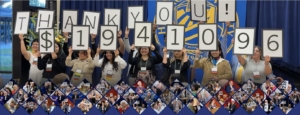
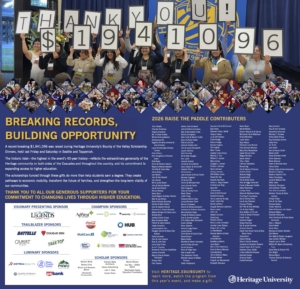
A group of people holding up signs

Students reveal the amount raised during the 39th Annual Bounty of the Valley Scholarship Dinner on June 7, 2025 at Heritage University.


FOR IMMEDIATE RELEASE

Heritage University’s Bounty of the Valley Dinner Raises Record $1.29 Million for Student Scholarships

Toppenish, Wash.— Heritage University proudly announces that its 39th Annual Bounty of the Valley Scholarship Dinner raised a record-breaking $1,297,744 this past weekend, marking only the second time in the event’s history that it has surpassed the $1 million milestone.

For the first time since its inception, the event was held simultaneously at two locations—on the university’s campus in Toppenish, Washington, and at Aerlume Restaurant in Seattle. Three hundred guess between the two venues celebrated the university’s mission and honored the students whose lives are transformed by scholarship support.

In Toppenish, Heritage alumni Alex Vera and Brenda Castaneda served as co-emcees, while fellow alum Gerardo Ruelas and Rueben Mayes, former WSU and NFL football standout, co-hosted the program in Seattle.

A highlight of the evening was the appearance of all four of Heritage’s presidents—Founding President Sister Kathleen Ross, SNJMSecond President John Bassettcurrent President Andrew Sund, and incoming President Christopher Gilmer—who collectively celebrated the university’s enduring mission and remarkable growth. This year also marked the fourth consecutive year the program was live-streamed, allowing a broader audience to join in the celebration online.

Student speaker Elsie Blackwolf, a junior double majoring in American Indian Studies and Social Work, shared her powerful story of how scholarships have enabled her to pursue higher education. She spoke of her deep commitment to the Yakama Nation and her plans to return and serve her community after graduation. The event also featured a heartfelt video of three graduating seniors reflecting on their academic journeys and expressing gratitude to donors.

Since its founding, the Bounty of the Valley Scholarship Dinner has raised more than $11.6 million for student scholarships. Heritage University extends heartfelt thanks to the donors and sponsors whose generosity continues to change lives.

# # #

Heritage University fundraiser to feature presidential reunion and sneak peek at new Adelante STEM Center

FOR IMMEDIATE RELEASE

Heritage University fundraiser to feature presidential reunion and sneak peek at new Adelante STEM Center

Toppenish, Wash. – Heritage University will host its 39th Annual Bounty of the Valley Scholarship Dinner on Saturday, June 7, 2025, bringing together its past, present, and future presidents for a celebration of student achievement, community, and innovation. The university’s premier fundraising event for student scholarships will also include an exclusive preview of the new Adelante STEM Center, located in the Kathleen Ross, SNJM Center.

This year’s event marks a historic occasion as all four university presidents—Founding President Kathleen Ross, SNJM, Second President John Bassett, current President Andrew Sund, and incoming President Christopher Gilmer—will come together to celebrate Heritage’s mission and continued growth.

Guests will enjoy an evening of fine dining and entertainment, including hors d’oeuvres, artisan cuisine, exquisite desserts, fine wines, and craft beer, served throughout various locations on the Heritage University campus. Doors open at 4:30 p.m., and tickets are $200 per person.

The evening will also feature inspiring stories from current students, as well as cultural performances from a mariachi band and a Native American drum group, honoring the rich heritage of the Yakima Valley community.

For those unable to attend in person, the Scholarship Dinner will be live streamed on the university’s website, ensuring everyone can support student scholarships and be part of this special evening.

For ticket purchases, live stream access, and additional event details, visit: Heritage.edu/Bounty. For more information, contact Davidson Mance at (509) 969-6084 or Mance_D@heritage.edu.


# # #

Heritage University to hold Class of 2025 Commencement at Yakima Valley SunDome

FOR IMMEDIATE RELEASE

Heritage University to hold Class of 2025 Commencement at Yakima Valley SunDome

Yakima, Wash. – Heritage University will celebrate the Class of 2025 at Commencement on Saturday, May 10, at 10:00 a.m. at the Yakima Valley SunDome. Undergraduate and graduate degrees will be conferred upon students graduating from the Heritage Toppenish campus and the Tri-Cities regional site. Overall, 181 students earned their degrees at Heritage this year.

JoDe Goudy, who is a deeply rooted Yakama leader, visionary, and advocate dedicated to preserving and advancing his Native culture, the environment, and future generations, will present this year’s commencement address. He is the owner and founder of Redthought, a Native-owned organization committed to fostering respectful relationships with Mother Earth and ensuring a sustainable future for all generations.

A former Chairman of the Yakama Tribal Council, Mr. Goudy has an extensive history of service to his people, having shaped and led initiatives to address crucial social, cultural, and environmental issues. Currently, he serves as the Vice-Chairman of Se’Si’le, a non-profit organization focused on protecting the rights and ways of life of Native nations. Goudy’s professional journey includes significant work in both the corporate world and the realm of Native leadership. His life’s work has been dedicated to advocating for the rights and dignity of Indigenous peoples, including challenging the Doctrine of Christian Discovery through legal and diplomatic channels, from the Yakama Nation to the Vatican. His work with Redthought is driven by a desire to bring clarity and coherence to the global conversation on sustainability, justice, and the respect for traditional ways of life. Through his experiences, Goudy has fostered a deep understanding of identity, reality, and the interconnectedness of all people and the environment. His personal reflections and advocacy are centered around powerful questions: Who am I? Where do I come from? Where am I going? What is? What isn’t? Why? These questions guide his efforts to unite diverse communities in creating meaningful change.|

Heritage University will present the 2024 Violet Lumley Rau Outstanding Alumnus Award to Maria Zavic Batarao. Batarao currently serves as the Executive Director of Instructional Technology and Assessment at the Wapato School District, where her leadership has been instrumental in improving educational systems and student outcomes. Her career in education is as diverse as it is inspiring, beginning as a classroom teacher, evolving into a Reading Coach, and later becoming the pioneering principal of Simcoe Elementary School before settling into her current position. Her journey reflects a deep and enduring dedication to serving the students and families of her community.

Batarao’s impact extends far beyond the classroom. She serves as the advisor for the Filipino American Community of the Yakima Valley’s Batang Wapato Youth Group, using the performing arts to help young people explore and celebrate their cultural heritage. Her work ensures that Filipino traditions are honored and passed down, creating a bridge between generations and cultures. She is a respected educational leader and a compassionate and selfless community advocate. Her humility, kindness, and genuine care for others have earned her the admiration of colleagues, students, and families alike. She exemplifies the spirit of service and leadership that defines Heritage University alumni.

The Yakima Valley SunDome is located at 1301 South Fair Ave. in Yakima. Parking is free. Additional information is available online at https://heritage.edu/commencement. For more information, contact Davidson Mance, media relations coordinator at (509) 969-6084 or Mance_D@Heritage.edu.


# # #

Joint Statement from Heritage University and Educational Service District 105 on the Premature Closure of the Yakima Grow Your Own Consortium

 Joint Statement from Heritage University and Educational Service District 105 on the Premature Closure of the Yakima Grow Your Own Consortium

Yakima, WA  [May 2, 2025] —On April 29, 2025, Educational Service District 105 (ESD 105) and Heritage University received notification from the U.S. Department of Education that the federal funding for the Yakima Valley Grow Your Own Consortium and Masters in Mental Health Counseling will be discontinued.

The grants and this partnership between ESD 105 and Heritage University are designed to address the critical shortage of school-based mental health professionals in South Central Washington by cultivating a locally trained workforce dedicated to serving the region’s schools and communities. Through Master of Social Work (MSW) and Master in Mental Health Counseling (MMHC) pathways, the initiative supported candidates from underserved communities to become school social workers and behavioral health providers in the very regions they call home.

The program has already demonstrated significant success:

  • 17 students are on track to graduate with their MSW and are set to complete  school-based internships in May.
  • 18 students are completing their first year in the MMHC program and are scheduled  to begin school-based internships this August.
  • These future professionals represent a vital step forward in filling the mental health gaps in our region’s schools.

The federal funds supported a goal to graduate 20 MSW per academic year and 50 MMHC professionals over its duration to work in school-based settings, positions that are critically needed in Yakima County and surrounding areas.

As an example, the school counselor-to-student ratio in several area districts exceeds 1:1,000, with some districts employing no school social workers at all. The recommended national ratio for school counselors is 250:1.

The need for mental health services among youth in our region is urgent. According to the 2022 Healthy Youth Survey:

  • 57.1% of 8th-grade students from the ten districts participating in our consortium expressed worries about their family losing jobs due to the pandemic (vs. 38.8% statewide).
  • 50.6% of 12th graders reported no contact with a school counselor in the past year.
  • 14.2% of 8th-grade students reported not feeling hopeful, and 12.8% had attempted suicide in the past year, significantly higher than state averages.

In a rural region already facing systemic barriers to behavioral health care, this loss disrupts the pipeline for trained school-based mental health professionals; it also threatens long-term efforts to create sustainable, culturally responsive mental health services.

“The loss of these grants will have lasting, negative impacts on our schools and communities,” said Emily Nelson, Executive Director of Student Support, at Educational Service District 105. “We already face significant delays and barriers in youth access to behavioral health services, and these grants were designed to address those challenges by bringing more qualified professionals into schools and communities.”

Heritage University and ESD 105 are currently working to support enrolled students and are appealing the decision by the Department of Education to reinstate funding as well as actively seeking alternative funding and partnership opportunities to preserve this essential work.

“Heritage University is fully committed to maintaining the Masters of Social Work and Masters of Mental Health Counseling degree programs,” said Andrew Sund, President of Heritage University. “The loss of this funding will make it more challenging for us to gain access to highly skilled school-based supervision for placements. We will also see fewer school-based practitioners to meet the needs of the local school districts.”

This is not the end of our commitment. It is a critical reminder that our students, families, and schools deserve the same access to care and support as those in better-funded regions. We remain dedicated to that vision.

For more information, please contact Dr. Melissa Hill, Provost/Vice President of Academic Affairs (509) 969-4013 or hill_m@heritage.edu.

About ESD 105:

ESD 105 supports 25 public school districts and more than 21 state-approved private and tribal schools in South Central Washington.  The agency serves the expressed needs of those schools in coordinating and conducting cooperative programs to benefit the approximately 66,000 K-12 students who are served in Kittitas and Yakima counties and portions of Grant and Klickitat counties.  As one of nine ESDs in the state, ESD 105 carries out liaison activities between local school districts, the Washington State Office of Public Instruction, and the State Board of Education.

About Heritage University:

Heritage University is a private, non-profit, regionally accredited institution of higher learning offering undergraduate and graduate education from its primary campus in Toppenish, Wash. and from regional sites in Kennewick, Wash. and Pasco, Wash. Heritage University is located on the Yakama Nation and is both a Hispanic Serving Institution and a Native American-serving Non-Tribal Institution. For more information, visit heritage.edu.

# # #

Dr. Andrew Sund’s Campus Farewell Party

All Nations Student Social Powwow returns to Heritage University on April 19, 2025


Heritage University Powwow on April 19, 2025, featuring dance, drumming, vendors, and a salmon bake.

Heritage University All Nations Student Social POWWOW


FOR IMMEDIATE RELEASE

All Nations Student Social Powwow returns to Heritage University on April 19, 2025

Toppenish, Wash. – Heritage University’s All Nations Student Social Powwow is returning to Heritage University on Saturday, April 19, 2025. Hosted by the Heritage University Native American Club (HUNAC),  the powwow celebrates Indigenous culture. This social gathering is a free event and open to all.

The powwow will highlight dancers and drum groups. Dancers will perform traditional, fancy, jingle, and grass dancing, with youths to seniors participating. The first ten participants in each category including men, women, teen girls, and teen boys will receive bundles of traditional foods and medicines and HUNAC regalia. Tiny tot dance participants will receive gifts. Drum groups are welcome. Vendor set up begins at 8:00 a.m. and have first come first serve access to electricity. Dancer and drummer registrations open at 10:00 a.m., with the Grand Entry occurring at 11:00 a.m.

HUNAC President and lead event organizer Anany Scott is thrilled for the return of the powwow to Heritage University. “We are excited for this event which has turned into an annual tradition of sharing our culture with the campus community and beyond. Our event has continued to grow, and we hope to see many more people at the powwow this year. Year after year, our vendors have contributed so much to the spirit of our event, and we are looking forward to their return. We are also grateful to our sponsors, the Presenting sponsor, Johnson Scholarship Foundation and South Central Workforce which is a substantial underwriter of the event. We thank them for their support,” said Scott.

Other highlights will include a Missing and Murdered Indigenous (MMIW) Dance Special, an Easter Egg hunt for kids ages one to 10 and a salmon bake. Organizers invite vendors to sell food, arts and crafts, and general merchandise during the event. Yakama Nation agencies and non-profit organizations are also invited to participate in a community resource fair. Student clubs from Heritage, area high schools or other colleges and universities are welcome to host informational or fundraising booths. To learn more about vendor requirements or to apply to be a vendor, please visit please visit heritage.edu/powwow.

For more information or help with interviews, please contact Davidson Mance, media relations coordinator at (509) 969-6084 or Mance_D@heritage.edu.

# # #