Comments sought for Heritage University accreditation

FOR IMMEDIATE RELEASE

Comments sought for Heritage University accreditation

Toppenish, Wash. – Heritage University is accredited by the Northwest Commission on Colleges and Universities (NWCCU). Its accreditation status was most recently reaffirmed in spring 2019 after the acceptance of the university’s mid-cycle evaluation.

On April 22 – 24, 2026, NWCCU’s accreditation evaluation team will be visiting Heritage University to confirm and verify the content of the university’s Evaluation of Institutional Effectiveness Report through collegial and compliance peer review and feedback for continuous improvement. As part of the process, Heritage University invites third party entities to submit their signed, written comments to:

Northwest Commission on Colleges and Universities
8060 165th Avenue NE, Suite 100
Redmond, WA 98052
(425) 558-4224

For electronic third-party comments, please use the link to access NWCCU’s electronic submission portal.

Comments must be received by the Commission no later than April 12, 2026. The NWCCU will consider all comments on Heritage University’s qualifications for accreditation. All signed comments will be forwarded, as received, to Heritage University, the evaluation committee, and the Commission.

To obtain a copy of Communication with Accreditation Constituencies go to www.nwccu.org and visit the Policies page on the website, or contact the Commission office at (425) 558-4224.

# # #

Heritage University President Announces Major Leadership Expansion and Bold Vision for the Future

FOR IMMEDIATE RELEASE

Heritage University President Announces Major Leadership Expansion and Bold Vision for the Future

Toppenish, Wash. – Heritage University President Dr. Chris Gilmer has announced a broad expansion and reorganization of the university’s leadership team, paired with strategic initiatives designed to strengthen student success, deepen community partnerships, and position Heritage for continued growth as it approaches its 50th anniversary in 2033.

Central to the expansion is the appointment of Sagrario Armenta-Jimenez as Vice President of Administration and Chief Financial Officer. Armenta-Jimenez brings extensive experience in education finance and operations. “Sagrario is an exceptional leader whose commitment to transparency, fiscal stewardship, and student-centered decision-making aligns perfectly with the direction we are taking Heritage University,” said Dr. Gilmer.

Dr. Gilmer also announced a series of leadership promotions, including David Wise, who has been elevated from Vice President to Senior Vice President of Advancement, Marketing, and Admissions. During Wise’s tenure, Heritage has more than doubled annual giving from $1.5 million to $3.1 million and secured transformative philanthropic investments, including a historic $10 million unrestricted gift, a $6.3 million scholarship gift, and a $2 million endowed chair in nursing.

Crystal Sampson has been promoted to Chief of Staff to the President and Vice President of Operations, formalizing a role she has effectively filled since Dr. Gilmer’s arrival. With nearly 20 years of leadership experience at Costco and service within the Yakama Nation’s administration, Sampson becomes the first enrolled member of the Yakama Nation to hold the title of Vice President at Heritage University—reflecting Gilmer’s commitment to leadership that mirrors the university’s community and strengthens relationships with tribal nations.

Additional promotions include SaraBecca Martin to Associate Vice President for Academic Affairs, expanding her role overseeing accreditation, institutional effectiveness, and academic planning, and Adriana Villafan to Associate Vice President of Student Affairs, recognizing her leadership of high-touch, wraparound student support programs. Apart from Armenta-Jimenez, these roles represent reclassifications of internal talent rather than new hires, underscoring Heritage’s commitment to recognizing and elevating its own leaders.

Dr. Gilmer has also launched a national search for a new Vice President for Academic Affairs, signaling a renewed emphasis on academic innovation and excellence. He has also expanded the senior leadership team to include a student voice for the first time, appointing Student Government Association President Mercedes Garcia to the president’s leadership table. “Having students help shape decisions that affect their lives and learning is essential to who we are as an institution,” Gilmer said.

Dr. Gilmer also shared an update regarding the future of Heritage University’s Tri-Cities operations. Beginning in January 2026, these operations will report directly to the President as the University advances a new leadership model and develops an expanded investment plan for the region. This approach reflects an enhanced dedication to the Tri-Cities and a strategic focus on growth, innovation, and long-term impact. “This is a commitment to growth and new direction,” Gilmer emphasized.

In addition to leadership changes, the university has launched a $1 million fundraising campaign to eliminate hunger on campus, addressing food insecurity as a critical barrier to student success. “No student should ever have to choose between their education and their next meal,” said Gilmer.

Looking ahead to Heritage University’s 50th anniversary in 2033, Dr. Gilmer’s vision includes assertive fundraising, expanded academic programs, deeper community engagement, and building a national reputation that reflects “the excellence Heritage already demonstrates every day.”

“Heritage University has a powerful mission and a remarkable community,” Gilmer said, “We are investing boldly in our future—our students, our people, and our partnerships.”

For more information, please contact: Davidson Mance, Media Relations Coordinator at
(509) 969-6084 or mance_d@heritage.edu.


# # #

Heritage University protects students from state financial aid reductions

FOR IMMEDIATE RELEASE

Heritage University protects students from state financial aid reductions

Toppenish, Wash. – Heritage University announced today that it will fully protect students from the State of Washington’s planned reduction to the Washington College Grant (WCG), ensuring no decrease in student financial aid for the 2026–2027 academic year.

The Heritage University Board of Directors has approved the use of university reserve funds to completely replace the state’s anticipated cut to the WCG. As a result, students’ total financial aid packages will remain whole—assuming their Student Aid Index stays the same. When 2026–2027 financial aid award letters are issued, students will see an increase in university-provided funding (HU Excellence), which will directly offset the state reduction.

“We want all our students, present and future, to know that they won’t be impacted by the reduction of the Washington College Grant in the coming year,” said Heritage University President Dr. Chris Gilmer. “We are committed to ensuring that no student loses support because of a state budget decision. Keeping education accessible is at the core of who we are.”

Dr. Gilmer says Heritage University administrators are actively engaging with Washington Governor Bob Ferguson’s office and state lawmakers to advocate for the full restoration of the WCG. The university is hopeful the Legislature will reverse the planned cut during the upcoming legislative session. Administrators will continue to keep students informed as developments occur. “The Yakama Nation Tribal Council is fully supporting our advocacy of the WCG, and I am grateful for the council’s solidarity on this matter,” said Dr. Gilmer.

“Heritage exists to open doors, not close them,” said Vice President of External Affairs David Wise. “We will always advocate for our students and take every step possible to ensure nothing stands in the way of their education.”

Students with questions about their financial aid are encouraged to contact the Heritage University Financial Aid Office, where staff are ready and available to assist. For more information, please contact Davidson Mance, media relations coordinator at (509) 969-6084 or mance_d@heritage.edu.

# # #

Heritage University Has Your Back

Hi Eagles,

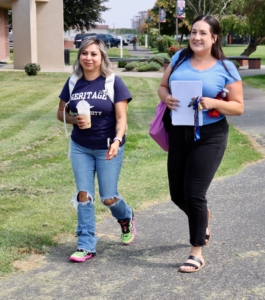
Two women walking on a pathWe want you to know something important: your financial aid is safe.
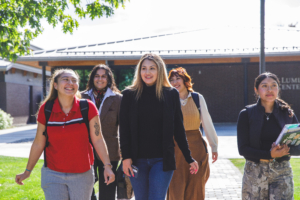
Even though the State of Washington is planning to reduce the Washington College Grant (WCG) for the 2026–27 school year, Heritage University will cover the entire cut so that your total financial aid does not go down (as long as your Student Aid Index stays the same).A group of people walking

Our Board of Directors has approved using university reserve funds to fill the gap. When you get your 2026–27 financial aid award letter, you’ll see an increase in HU Excellence funds from Heritage—that’s what will make up for the state’s reduction.

President Chris Gilmer put it clearly: We don’t want any current or future student to lose support because of a state budget decision. Keeping education accessible is part of who we are.

A group of people standing in a room.

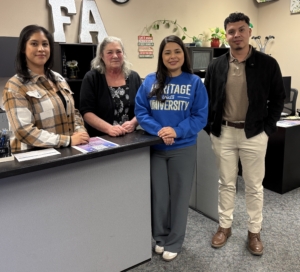
The Heritage University Financial Aid Team

Heritage is also working with state lawmakers to advocate for restoring the full Washington College Grant. We’re hopeful things will change, and we’ll keep you updated as we learn more.

As Vice President of External Affairs David Wise said: Heritage exists to open doors, not close them. We’ll always stand up for our students and do everything we can to support your education.

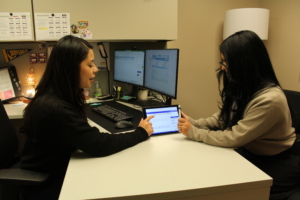
If you have questions about your financial aid, please reach out to the Financial Aid Office at (509) 865-8502, email them at Financial_Aid@Heritage.edu or visit the team in the Student Services Center (2000 Building).A person showing something on a tablet to another person


Read the
“Heritage University protects students from state financial aid reductions”
press release here.

El Grito – Wings Fall 2025

A person holding a flag


The Heritage campus came alive with color, music and tradition in September as the community gathered for the university’s El Grito celebration.

A collage of people engaging in activities at El Grito

El Grito is one of Mexico’s most cherished traditions, commemorating the start of the nation’s war for independence. Each year on September 15, the president of Mexico rings a bell at the National Palace in Mexico City and delivers the Cry of Dolores, echoing the historic call made by Miguel Hidalgo y Costilla more than two centuries ago. The ritual is repeated across Mexico and beyond, carrying the same patriotic significance that the Fourth of July holds in the United States.

Heritage has hosted its own El Grito celebration since 2018, honoring the heritage shared by many of its students and creating a bridge between the university and the broader community. This year, with the holiday falling on a Sunday, the celebration was held the Friday before, with the reenactment of the Cry of Dolores moved to 7:00 p.m. instead of the traditional 11:00 p.m.

The festivities featured vibrant performances of Aztec dances, folkloric traditional dancing by Grupo La Esperanza, and lively music, which kept the crowd on its feet. Families enjoyed traditional crafts, games and activities, while community organizations hosted a resource fair. A highlight of the evening came when Mexican Consul Representative Oscarlin Figueroa Garcia led the crowd in the powerful Cry of Dolores, uniting all in a moving moment of history and pride.

A collage of people enjoying El Grito activities

Honoring Our Elders – Wings Fall 2025

A collage of Native American elders


November is Native American Heritage Month. Each year, Heritage University honors four Yakama elders for their lifetime contributions to their communities. This year, we recognize Terry Goudy-Rambler, Stan Miller, Wilber Slockish Jr, and Ramona Kiona.

TERRY GOUDY-RAMBLER, TSAGAGLALAL has spent her life lifting the Yakama people and protecting the sacred promises of the Treaty of 1855. Born at Celilo Falls, she carried the strength of her ancestors when her homeland was lost to the dam and transformed that loss into fearless advocacy. In the 1970s, she stood on the front lines to defend treaty fishing rights, courageously challenging boundaries on the Columbia River. She helped pave the way for tribal self- governance under the Indian Self-Determination and Education Assistance Act, giving her people control of their own future. Through her 25 years of working for the Bureau of Indian Affairs, followed by more than two decades of service on the Yakama Nation Tribal Council, Terry’s unwavering leadership has inspired generations and remains a shining testament to sovereignty, resilience, and justice.

MOX MOX WA PA LE LE COT, STAN MILLER has lived a life of service, guided by faith, honor, and commitment to his people. He served in the United States Marine Corps during the Vietnam era, spending three years stationed at MCRD San Diego, California, where he served as a military policeman and legal clerk. Later in life, Stan confronted and overcame personal demons, choosing to devote himself to faith and service. As chaplain of the Yakama Warriors Association, he offers comfort and strength to veterans, their families, and their communities in times of deep need. For the past 12 years, he has served faithfully as one of six elected members of the Yakama Nation’s Code of Ethics Board, providing oversight to ensure that all elected tribal leaders uphold the highest standards of integrity and accountability. Through his resilience and devotion, Stan embodies dignity, compassion, and an unwavering commitment to his people.

WILBUR SLOCKISH JR., SLA-KISH has dedicated his life to defending the fishing rights promised to the Yakama people in the Treaty of 1855. In the 1980s, he was arrested and imprisoned for exercising those rights, a sacrifice that drew national attention and led to landmark changes that brought tribes into partnership with government agencies to manage salmon, while prioritizing tribal fishing above commercial and sport interests. After his release, Slockish turned to educating non-tribal communities about traditional food gathering and has continued to serve as a powerful voice for environmental stewardship and treaty protections. Today, he represents the Yakama Nation on the Columbia River Inter-Tribal Fish Commission, where he works tirelessly to protect salmon, rivers and the cultural lifeways of his people.

RAMONA KIONA, TENIBA is a master weaver dedicated to preserving the traditional art of Klickitat huckleberry baskets. Using materials and techniques carefully passed down through generations, she creates intricate works that reflect both the beauty of the land and the strength of her people’s traditions. More than art, her weaving is a living expression of Yakama identity and resilience, tied to the seasonal harvest of huckleberries and the stories carried in each pattern and stitch. Committed to ensuring this cultural treasure does not fade, she shares her knowledge with future generations from the four bands of the Confederated Tribes of the Yakama Nation. By teaching others to weave, she preserves not only an endangered art, but also an essential part of Yakama culture and heritage—keeping alive the connections between people, land, and tradition for the generations yet to come.

Beyond Shakespeare – Wings Fall 2025

A banner with a dragon and roses and lettering Beyond Shakespeare

Heritage’s master’s program in literature elevates multicultural voices with a focus on Indigenous and Hispanic literature, sharing of lived experiences, and empowering students.


In the fall of 2024, students in a new Heritage University course called “Writing for Change: Advocacy and Civic Engagement” spent the semester delving into the issue of food sovereignty — the right of peoples to healthy, culturally appropriate food that is produced using sustainable, ecological methods.

By the end of the semester, they’d gained insight into the process of issue advocacy based on thoughtful, systematic research and study.

Guided by Ann Kendall, assistant professor of literature and languages, they also learned how to become part of the civic process through communication designed to get to the point and capture a reader’s attention.

Several students’ opinion pieces were published in the Yakima Herald-Republic — three of them written by students in a master’s program that’s been recently “retooled” — the Heritage’s Master of Arts in Multicultural English Literature and Language program. Their opinion pieces began with strong points of view:

“For the one person out of nine in our country who is considered to be food insecure, a trip to the grocery store is a luxury.” – Jackie Bell

“Imagine an indigenous community without diabetes. Can you? Probably not. However, this can be an attainable future by giving Native Americans food sovereignty.” – Josefa Zarco

“How many times a week, or say a day, do you consider those who are harvesting the produce in your fridge? Think hard about how they produce products and the moral and human rights of those who harvest, pick, and pack each individual fruit.” – Anjuli Barragan

Over the years, perhaps only a few of these master’s candidates will write for a living. But all of them will need to communicate effectively as part of their work.

VALUING “GIVE AND TAKE”

Professors in Heritage’s Multicultural Lit program don’t teach a traditional canon of English literature to their students. There’s no focus on the traditional Homer, Shakespeare or Milton. Its core courses have been curated specifically for the students who take them.

Classes such as Hispanic Literature, Native American Literature, Women’s Literature, Memoir Writing, and Writing for Change: Advocacy and Civic Engagement speak to the Heritage student population.

A drawing of a person named Jim Dugan who's wearing a blue shirt

Jim Dugan

“We’re studying contemporary writing in literature, novels, short works and non-fiction, which is incredibly important in today’s world,” said James Dugan, chair of the Department of Literature and Languages.

“Virtually every literature selection reflects students’ lives and the lives of the people they know,” Dugan said. “They, in turn, bring their lived experience to the table, something that’s as important as what any professor has to teach.

”It creates an opportunity for people to actually be in community with other people whose narratives are represented in this literature.”

CHOOSING TEACHING FOCUS OR THESIS FOCUS

Most students come to the program already working in their communities. Their undergraduate degrees are in English, history, education and art. They are K-12 teachers, higher education instructors, professionals working for non-profit organizations, and people working in business.

“We specifically seek a diversity of backgrounds and perspectives, a cohort of learners that truly reflects the multicultural perspective of the program,” Kendall said.

Students select from two focuses: The Teaching Focus is for students already certified to teach in K-12 and interested in dual- enrollment programs or community college teaching. The Thesis Focus is for students most interested in pursuing Ph.D. or M.F.A. studies, community college or university-level teaching, and private/public sector opportunities.

“If you’re a teacher, we’ll help you figure out how to create lesson plans around, for example, the literature of Native American people from the area in which you teach,” Kendall said. “We’re also teaching how to find the literature you need, whether you’re back in the classroom or you need it on the job.”

“It definitely prepares someone who wants to teach,” Dugan said. “But people get the idea that if you study English, you’re going to become a teacher. That’s often not the case.

“The program is designed to help you navigate text, think critically about text, and communicate effectively with others, whatever your job.”

MASTER’S STUDIES MADE MORE ACCESSIBLE

A drawing of a person wearing glasses and smiling with a banner that reads Ann Kendall

Ann Kendall

Master’s students learn early on that Heritage is all about relationships, Kendall said, and students don’t have to be on campus to experience that. They can attend classes virtually or in person.

Virtual attendance makes it easier to add graduate school to full-time employment and family responsibilities, a necessity for many. The foundational, warm Heritage welcome and support, wherever needed, is present whether a student is on campus or attending class virtually.

“We’re high touch, even if students are remote,” Kendall said. “That isn’t always the case with a lot of universities.”

Heritage’s small class sizes and low student-to-instructor ratio make it possible for instructors to be present for students, who often have a lot to juggle in addition to their studies.

It’s something Kendall knows first-hand. As a non-profit executive for two decades, she’d always dreamed of being an English professor. She just needed her master’s.

“I lived in Seattle then and started looking around for something that would work with both parenthood and my full-time work schedule,” Kendall said. “I hit a brick wall.

“Then I found Heritage, and I said, ‘Well, this is completely different.’ I enrolled.

“Students don’t even have to leave home to be part of this program.”

DISSECTING THE LITERATURE TOGETHER

What takes place in these classes, said Dugan, “is that we’re really dissecting the literature together.

“Students have considerable lived experience. They’re not just coming in like sponges waiting to hear things. Our discussions are eye-opening, and they can be very humbling for me.”

Recently, a master’s student who is a full-time teacher shared what she calls her “mantra” with Dugan.

“She said, ‘If you’re working harder than your students, you’re doing it wrong,'” said Dugan. “That doesn’t happen at Heritage. Everyone is really involved in the conversation. We’re all learning, all the time.”

The President’s Address – Wings Fall 2025

People in Native American regalia on a stage with people in higher education regalia paying attention to the university president's address


Good morning, and please allow me to begin with my own family, because ours is the only story that I have fully earned the right to tell. My Papaw Carlton quit school in the first grade and spent his life plowing the fields that fed his family. He was the only brother of seven sisters, and it was not considered appropriate in those days for women to walk behind a mule and plow. By the time I was in first grade, I was reading the newspaper and legal documents to him, the written English language almost as much of a mystery to him as to some of the migrant workers in the Yakima Valley, whose children and grandchildren translate for them today. He died owning without debt 50 acres of farmland, a modest herd of cattle, a Massey Ferguson tractor, an old Chevrolet pickup truck, a well-worn green Plymouth Valiant car driven by my grandmother and later driven to college by me after her passing, and the little dog-trot house on the red clay hill on the Road to Damascus, Mississippi, where I spent the happiest days of my life as a young child.

A group of people holding flags

Heritage faculty and staff carry the gonfalons representing the different programs during the procession of the Installation ceremony.

Little did I know that they would be the only carefree days of my life, carefree just long enough for me to come to understand adult responsibilities long before I was an adult in years. Papaw became so respected in that tiny hamlet without a traffic light, post office, or store that he was later selected to serve on the school board at the school in town, an especially poetic irony considering his earlier unselfish educational choice. My Mamaw Sarah, his beloved wife, ran the lunchroom at the school, cooking and serving thousands of school lunches with a smile, so it is no mystery why I remember her fried chicken and biscuits as the best I have ever tasted. Her retirement check was just over $100 a month. Of their three sons, my father, Charles, is the eldest. Struggling honorably with a debilitating illness that has stolen his mobility, but not his spirit, he joins us online today, along with my beloved sister back in Mississippi. They are not able to be here in person, but I love and salute them across miles and decades. My sister, Holly, sent me a beautiful pocket watch, a most appropriate gift to commemorate a moment in time.

And now I will try hard not to cry as I remember the person who, besides them and my David, would have most wanted to share this moment.

Some of you have heard me say that my mother, Peggy Carolyn Adams Gilmer, was born on the kitchen table of a sharecropper’s shack at the end of a cotton field and that my sister still has that table. My father’s family was slightly more prosperous, although very much part of the working poor, but my mother’s family was a product of multigenerational poverty. It is because my mother was pulling and filling a cotton sack from childhood on land her parents never owned, because as a child she lived through and overcame pretty much every kind of domestic abuse imaginable, successfully breaking the cycle of abuse with her own children, because she gave up her dream of a college education despite her natural brilliance so that my sister and I could be the first in our family to go to college, because she fought a long mental health battle with the demons of her childhood and finally won that battle in time to experience her grandchildren burden-free, because she read bedtime stories and the great works of literature to her children and grandchildren, because injustice in any form disgusted her and she reared her children to be advocates for equal rights, and because she and the rest of my family gave me the single greatest gift of my life—determination that I freely admit often transcends into stubbornness—I have the privilege of standing before you today as your fourth president, my heritage in so many unlikely ways not that different than the heritage of this essential university, America’s Essential University, and I would guess not that different than many of your own stories. If some in my family had not sacrificed all, and all had not sacrificed some, I would not be here. As the singer/songwriter Jewel reminds us: “I am the accumulation of the dreams of generations, and their stories live in me like holy water.” We are all the accumulation of the dreams of generations. Please raise your hand if you can say the same about your own family in any of the three languages. Look around at the sea of hands. I could stop here with my sermon preached, but those who know me know I will not stop quite yet.

A group of people walking with flags

From selling my blood plasma in college to buy gas for that old Plymouth to working multiple jobs in high school and college as a fry cook, grocery store bag boy, and later as a journalist because I wanted my beautiful sister to have the red dress in the dress shop window and my mother to have a simple ring with two small pearls and a few tiny sapphires, (her birthstone), from hearing the doctors tell us that my father would not live through the night as he lay in the hospital with Rocky Mountain Spotted Fever and driving home, still in high school, to borrow the money to pay for a funeral which thankfully was not needed since he fought his way back to life, I did what I was called like so many of our Heritage alumni and students to do, to slowly begin the cycle of lifting my family out of multigenerational poverty. I did what I had to do, and this is just some of it. It was not always pretty. I apologize to no one for it. I would do it again. Education was my constant, irreplaceable tool, and I dare say that this same stubbornness that preserved a family will serve Heritage University well in difficult moments when I will fight for us to keep climbing and never give into fading to oblivion.

Like my friend Ann just sang so beautifully, I did break my heart for every gain. To taste the sweet such as this moment, I have indeed faced the pain. Many of you, most of you probably, have broken your own hearts and faced your own pain, but like Celie says in Alice Walker’s Pulitzer Prize-winning novel, “The Color Purple,” “Dear God, I’m here.” So are you here, although I bet, like me, many of you are here despite someone who told you that you never would be. For me to earn the right to occupy this space, this one moment in time, and the moments we will have together in the coming years, I must be willing to fight with the last breath in my body, I must be willing to love with the last joy in my soul, those who have not yet found their own voices or who are still too afraid to use them. It is my job. It is my honor. It is my joy to be their champion.

A group of people singing

I have always been stubborn without apology because stubbornness allowed my family to survive, to have a roof over its head, food on its table, clothes on its back, and pride in its independence. I have never been truly hungry or homeless, but I have been days, maybe even hours, from each of these, the greatest fear not for myself, but that someone I loved and felt responsible for would be there with me. Have any of you ever felt that way? The question can remain rhetorical.

I do not know what it is like for the lands of my ancestors to be forcibly and illegally taken by people who looked a lot like me. I do not know what it is like for my ancestors to have been sold and owned as slaves by people who looked a lot like me. I do not know what it is like to be a parent or a child brutally separated from family and deported by people who look a lot like me. And I do not know what it is like to be a brilliant woman forced to pretend to be less than men, but my mother knew, again by people who looked a lot like me. I claim no experience not my own lived experience, but I do understand what it is like to be poor and smart, underestimated and filled with dreams. I know what it’s like to have holes in my shoes and to watch my beloved Granny cook a pot of soup or beans to eat all week long, listening to her singing her joy-filled song while preparing it. I know what it is like to carry a bucket of red tomatoes, the bucket almost as big as the boy carrying it, down a terrace row of ripe tomatoes that felt like it was half a mile long in the hot July sun, from the field to the house, and then to go back for another. I know what it is like to have to work harder as an LGBTQ+ leader in higher education, still one of few presidents, to gain the same position and respect that came easier to others. I know what it is like to have been an obese child and youth, ridiculed in my ill-fitting clothes, and yet still the person off of whose test papers the others wanted to cheat. I will not ask this time for a show of hands, but I suspect these and other lived experiences bind you to me and to each other. I do not compare in any way what I have overcome to what any of you still must overcome each day, some of your struggles so much greater than my own. I tell you truly and only that I empathize, and I am here for you.

A person shaking hands with a group of people

And lest this feel like a sad rather than a joyous moment, I remind us of the words of Nobel Laureate William Faulkner, who said: “I believe that man will not only endure, he will prevail.” I choose to believe he intended this prophecy to include all sexes and genders, races and orientations, and with respect to Faulkner, I suggest the defiant act of enduring, both individually and as a university family, is itself an act of prevailing. And for my part, I do it with no hint of self-pity and no desire for the pity of others, but with joy, with humility, with pride, and mostly with gratitude.

The future of Heritage University is indeed bright, a veritable temple of knowledge and wisdom willed into existence by two Yakama women, a Catholic sister, and others in the middle of a hops field. If they can defy those odds, my job is to ensure we defy any odds we face today and tomorrow. While we are each and all important, no one of us as a servant to the university is as important as the university itself and its mission. Surely, any university is always more important than its president. My dream is to build with you a future of financial independence, less reliance on state and federal funds, which means we must raise more money privately than we have ever raised. I cannot in good conscience ask anyone to support that which I do not support myself, so today, David and I announce that our personal fundraising goal will focus on the elimination of hunger on this campus. Yes, there are hungry people here, and hungry people cannot be expected to learn or to serve. Today I announce a presidential initiative to raise $1 million to provide no-cost meals to our students on campus and to anyone on campus who needs a hot meal. It will take a while to reach this goal, and while it is not a lot by the standards of some, because we are not wealthy people, we personally pledge $25,000 as the first donation.

A person wearing a feathered headdress and glasses

This initiative is the first step in a proposal I will make to our board of directors to launch the largest capital campaign in our history to culminate in seven years with the 50th anniversary of our university, and more information on this dream is forthcoming. Money follows purpose. Our purpose is noble, and I am confident we will position our university for even greater financial strength and independence in its second 50 years. And for any who prefers to make an investment rather than a gift, I have commissioned an external, unbiased economic impact study, the first in our history, which reveals the annual contribution of Heritage University to the State of Washington is valued at approximately $300 million, generated by an annual operating budget of less than $30 million. There can be no reputable economist who would not call that an amazing return on investment.

We must also evaluate our excellent academic programs and ensure that they are fully aligned with the needs of the communities we serve, and if the recent success of our graduate programs is any indication, Heritage is already doing a great job of that alignment. We will explore the addition of workforce development programs tied specifically to the needs of local employers, including the fruit-based and other agricultural industries. While we will always remain the place-based, face-to-face, community-focused institution we were founded to be, we will carefully explore as the nation’s only private Native American Serving Non-tribal University and Hispanic Serving Institution what online and hybrid options we might develop to serve a much broader regional and national audience, increasing enrollment while protecting academic integrity and reinvesting the funds we generate through off-site programs into our community-based campuses and into our greatest resource—our people. This new initiative, named Heritage SOAR, Scalable Online Academic Resources, has the potential to bring considerable new revenue to the university and to bring it quickly if we can gain the buy-in of all campus stakeholders. And speaking of soaring, we even have the potential to launch the first aviation program at a Minority Serving Institution such as ours, although this dream is in the early stages.

A person in a graduation gown and cap

There are more than 800 Minority Serving Institutions nationwide educating 20 percent of our nation’s students, and we are already exploring collaborations with them. We are preparing to fully launch the Dr. Kathleen Ross Institute for Student Success, named in honor of our beloved founding president and based on the ideals and pedagogy that she and many of you have proven here at Heritage in service to new majority and first-generation students. As far as I can tell, you are the experts, and why not be recognized and celebrated nationally as such? We will engage even more robustly with the communities we were founded to serve, such as the Confederated Bands and Tribes of the Yakama Nation, other tribal nations, and the Hispanic-Latino community, while preserving our commitment to serve everyone and to discriminate against no one. We will more fully reach out to and incorporate our proud alumni into our work, and we will continue to put our students forward as our best storytellers.

We will leave no valid and honorable pathway unexplored and see no obstacle standing in our way as a barrier, but rather simply as something to go over, through or around. This includes the challenging sociopolitical climate today, which affects all of higher education, but affects Heritage and our students much more deeply. I will stand with that student afraid in this moment to leave his, her, or their home to come to class, and I believe you will join me in continuing Heritage’s legacy as a safe place for all to come together, teach, and learn. We are strong now. We will be even stronger at age 50. We will together use the years of the presidency with which you honor me to ensure that the work of our founders was not in vain.

A person in a red dress standing at a microphone

In closing, the prelude to this event was “I Wouldn’t Take Nothing for My Journey Now,” an old Southern gospel song from my childhood that best describes how I feel in this moment. It also best describes the 24 years I have walked this pathway with my spouse, David, who, better than anyone I know, exemplifies the scripture found in the Book of Ruth: “Whither thou goest, I will go. Thy people shall be my people.” Through the best and the worst of times, and there have been plenty of both, there has never been a day I felt unloved because the unselfish, all-consuming love David gives is powerful. I honor him today and wish to share this life’s journey so fully with no one else. I thank the friends and beloved family of choice who came so far to be here and who are participating from their homes. I thank the board of directors for the opportunity to serve, and with absolute humility, I thank the students, faculty, staff, administration, alumni, and friends of Heritage University for all that this moment implies. And I thank the inaugural committee, the transition committee, and every person who worked so hard to make these events possible.

I was smart, but I was not the smartest. Neither was I the richest or the most handsome, the strongest or the fastest, the kindest or the most ruthless, but I remind anyone here who might be struggling that I am not special and that I am living proof of just one thing: what can happen when you are simply the most determined. I remember my great-grandmother, Onie Hannah Adams, descended of the proud Choctaw people of Mississippi, and in her memory, I honor the lands and the ancestors of the Yakama people, and indeed, I honor all of your ancestors who I hope will join with mine to bind us as one family across space and time. I make myself vulnerable to you today with this story, not self-indulgently, because I have no need to tell it. In this lifetime, my ego has been fully satisfied. I have been more than I thought I would be, so instead I share my story in the hope that some strand will resonate with some strand of your own story, and across all the differences which we honor, we will find a sameness that unites us. Never has such unity been needed more than now.

A person standing at a podium with a crowd of people sitting around

Reading Is an Adventure – Wings Fall 2025

A cover of a book

Reading Is an Adventure


From Grandview to Sunnyside, Yakima to Toppenish, you’ll see the banners: “READING IS AN ADVENTURE / LEER IS UNA AVENTURA”.

They’re on the fences at Catholic Charities Housing, displayed at Yakima Neighborhood Health Services, and seen throughout the Granger and West Valley school districts.

They’re promoting Yakima Valley Partners in Education’s (YVPE) continued initiative to improve educational outcomes for all youth from “cradle to career.”

What catches the eye, especially if you’re five or six years old, is the cute, gleeful-looking cartoon hamster springing into the air next to the words. She’s clearly delighted with the whole idea.

Named “Houdini,” this little critter has become the YVPE’s learning ambassador — and kids around the Valley know her for promoting the enjoyment and benefits of reading.

This year, she’s helping promote the partnership’s newest product: a board game and parent guidebook focused on making reading even more of an adventure.

A person and a child reading a book

A parent and her child read Reading Is An Adventure together

In the game, appropriately titled “Reading Is An Adventure,” young readers use colorful stickers to traverse the gameboard. The board features cartoon drawings of Houdini’s hamster wheel, her favorite foods — sunflower seeds and carrots — and a pathway with squares to be advanced for every 20 minutes a day a child reads.

The game’s parent guide is “designed to help you and your child get the most out of reading together,” explains the introduction. “[It] gives you the tools to lead your child through skill- building exercises that increase fluency and comprehension, expand vocabulary, and help them learn how to sound out words phonically.”

Parents and their children both benefit: Adults get a few tips on ways to help their kids read more fluidly and with greater comprehension, and young readers gain confidence in reading.

Its development comes out of a dedicated partnership between YVPE and Yakima Valley Libraries, whose community resource professionals are reading challenge experts.

Printed in the summer, the game was introduced beginning in August in Sunnyside, Granger, and Mabton, with planned distribution later expanding to the lower Yakima Valley, then the upper Valley.

ASSOCIATING READING WITH FUN

Houdini is seen on banners and signage; in walking/visiting mascot form at schools and community buildings; and, most ubiquitously, in the book written about her — Houdini Was.

Written and published 15 years ago by White Bluff Elementary teacher Christan Connors and her second-grade students as a tribute to their classroom pet, the book has captivated thousands of children.

Two years ago, Connors’s parents, Ken and Sharon Smith, bought the publishing rights from Scholastic so they could have the book reproduced with Spanish added to the English text. They printed 500 copies, distributing them to schools and other organizations in the Yakima Valley.

Bilingual copies of Houdini Was are in libraries, schools, health centers, and other community access points throughout the Valley.

In addition to the bilingual version of the game and the parent guide — painstakingly translated into Spanish by Yakima Valley Library Services Director Francisco Garcia Ortiz, Ph.D., and Lorena Legorreta, Heritage’s Food Security Community Liaison, YVPE organizers also hope to have the Reading Is An Adventure parent guide printed in Ichishkíin.

Just as Houdini Was books have received wide local distribution, 10,000 copies of the game and parent guide are being distributed this fall via many of the same partnering organizations, including Yakima Valley Libraries, community centers, financial institutions, and schools.

LITERACY STRATEGY FOCUSES ON COMMUNITY

As YVPE literacy efforts continue, the group has been implementing a community-based approach, said Suzy Diaz, Heritage’s Collective Impact Director for YVPE. That means looking more closely at how reading can be promoted within the community to support what is already being taught in schools.

To make that community focus happen, YVPE organizers work with those community- serving organizations that want to make books available to patrons via book kiosks. Five kiosks throughout the Valley hold as many as 100 books each; some have copies of Houdini Was, but mostly they’re books of all types, intended for young readers aged five to 12, all donated by literacy partners such as Save the Children. The kiosks are refilled regularly to meet patronage needs.

YVPE extends a portion of the funding it’s received, including that from major financial supporter The Ballmer Group, to Yakima Valley Libraries, whose role in supporting YVPE initiatives has grown.

“As reading promotion experts, Yakima Valley Libraries’ involvement has been key,” Diaz said.

READING CHALLENGES AND APP HELP FAMILIES TRACK

Yakima Valley Libraries’ focused reading challenges continue to increase reading participation among young children in the Valley. This summer’s challenge followed on the heels of what was a successful reading challenge over the winter holidays, said Sully Gama, Community Engagement and Impact Officer with Yakima Valley Libraries.

Children’s reading challenge progress is tracked via an app called “Beanstack,” which allows reading experts to gauge the number of active readers and total minutes logged.

There were 225 total active readers and almost 100,000 total minutes logged in the winter challenge, according to Gama. The highest participation was with early elementary students, which is the most crucial and targeted group for effective literacy growth.

A person in a mascot costume hands a book to a child

Houdini” hands a book to a young girl

GAMIFYING THE READING PROCESS

From the winter challenge’s results, YVPE and YVL organizers determined — and dreamed about — what children’s reading focus would come next. The concept of something “really interactive” kept coming up.

“David kept saying, ‘Let’s gamify this,’ Diaz said, referring to David Wise, vice president of Advancement and Marketing at Heritage. “He knew if we could figure out how to make this a game that kids and adults could play together, we’d really get some energy and engagement going.”

Diaz reached out to Xu Fang, Ph.D., Assistant Professor for the Teacher Preparation Program in Heritage’s College of Education. Diaz asked her, “If we could develop a parent guide to support healthy reading habits, what would that look like?”

“What’s typical and familiar to school-based communities is reading 20 minutes a day for maybe 30 days, after which students submit some kind of verification, and receive some kind of reward,” Diaz said. “That’s what we decided to do.”

For the game’s parent handbook, Fang developed a sort of “academic toolkit” consisting of the types of practices that have been proven to work best in encouraging young readers.

“The game makes forming healthy and productive habits really doable,” Diaz said.

ENHANCING PARENTS’ INFLUENCE

A mother and her child sit at a table while her child who's holding a book smiles at her

A young girl reads part of a book to her mother

The power of reading, a fuzzy little character that touches hearts and the imagination, and now “gamifying” reading takes commitment, Diaz said.

“It does take a village, and that’s what YVPE really is. It’s the people who believe and keep working at this. Along with YVPE’s many member organizations and the significant support from individuals, the perspective and impact of Yakima Valley Libraries have been truly meaningful.

“We all want kids to be engaged, and we all want parents to feel confident about their roles, which makes children more likely to feel confident and able to enjoy reading.

“We want them to spend quality time together, and we’re giving them more and more ways to do that.

“It’s an opportunity for parents and students to be engaged and involved in reading together in a way that’s fun and friendly,” Diaz said. “An enhanced parent-child experience enhances a child’s reading experience.

“And it’s parents who ultimately have the most influence on their young children.”


Planting Seeds of Healing – Wings Fall 2025

A close up of a sign


How Callyn Wagner is rebuilding behavioral health in her community.


When Callyn Wagner logs into her classes, she is not just earning credits toward her degree in Social Work. She is answering a calling.

Wagner, an enrolled member of both the Fort Peck Sioux Tribe and Turtle Mountain Band of Chippewa Indians, lives in Wolf Point, Montana, on the Fort Peck Indian Reservation. It is a place she describes as beautiful and tight-knit, yet also starkly underserved. The nearest Walmart is two hours away. Specialty medical care requires a five-hour drive to Billings—or, in many cases, a flight out of state. Behavioral health resources are especially scarce.

A woman pictured in a circle

Callyn Wagner

“We are in a behavioral health desert,” Wagner said. “If someone is in crisis, there’s almost nowhere for them to turn. I want to learn the skills to help people so I can create a safer place for my babies, for my family, for all of us.”

Now a senior studying Social Work, Wagner entered Heritage with a vision: to become one of those culturally grounded, homegrown professionals her community so urgently needs. Her journey from EMT to stay-at-home mom to domestic violence victims advocate, community organizer, and cultural advocate has been shaped by personal tragedy, resilience and an unshakable belief that healing begins with culture.

FROM EMERGENCY RESPONSE TO HEALING WORK

Wagner’s commitment to behavioral health has roots in her own family’s tragedy. When she was just 15, her older brother died by suicide. In the painful aftermath, her family sought help but struggled to find support that truly met their needs.

“We were connected with non-Native counselors, and it felt like we were counseling them about our culture instead of getting support,” Wagner recalled. “We need counselors who come from similar backgrounds, have similar life experiences, who understand our ways.”

Years later, before she became a student, Wagner was raising her two children and volunteering wherever she saw a gap. She served with the local EMT team, responding to emergencies that ranged from car accidents to postpartum psychosis. One incident in particular became a turning point. She was dispatched to help a woman in the midst of a mental health crisis.

“She was suffering greatly, and I kept thinking, There has to be something better than this,” Wagner remembered. “Her experience really stuck with me.”

Both her family’s loss and her experiences in the field deepened her conviction to help others at their most vulnerable. “I realized my passion was being that person others can lean on. I don’t want anyone to feel the way my family did—like nothing would ever get better.”

STEPPING INTO ADVOCACY

In 2022, Wagner attended an informational meeting about Heritage’s Behavioral Health Certification Program, which was being offered online and on the Toppenish campus. The credit- bearing, non-degree program trains people working with tribal communities to provide culturally responsive, holistic behavioral healthcare, especially in rural areas where access is limited. She didn’t have any preconceived notions about the program or even thoughts about going back to school.

“I thought this might be information that would interest someone,” she said.A group of people working on a project

It turned out that someone was her. Wagner quickly signed up and started classes part-time at the first opportunity. By 2023, she was all in, pursuing the certificate as well as a bachelor’s degree. At the same time, she began working as a domestic violence and sexual assault victim advocate on her reservation.

It was not an easy role. She had no personal experience with domestic violence and came from a stable two-parent household. “But I saw the need,” Wagner said. “The women I worked with had often been assaulted multiple times, sometimes starting in childhood.”

Her passion for serving women in her community led her to become certified to represent them in tribal court. She sat through forensic interviews with children. She took on unpaid tasks because, in rural communities, waiting for outside professionals often means waiting too long.

“I figure if I get trained, I can provide what is needed right here,” she explained.

RECLAIMING CEREMONY

The more Wagner searched for ways to help the women she worked with, the more she came to believe that healing began with a connection to culture.

“I realized we needed a cultural way of talking about our bodies—about how they are sacred, life-giving and deserving of respect.”

Wagner’s advocacy work is intertwined with her commitment to cultural revitalization. She saw that many young women she worked with in her community lacked guidance at critical moments, such as when they began menstruating.

“Our ancestors knew what they were doing,” she said. “There are seven ceremonies (in the Dakota way of life), and they include a naming ceremony. But many of us never had that first step. I realized that for us to heal, we need to go back to our roots.”

Wagner had a vision of what she wanted to do, but she didn’t have a clear path to lead the way. With her culture based on the oral tradition, learning about what to do wasn’t as easy as opening a book or asking Google. Instead, she reached out to elders who carry traditional knowledge. One in particular, Sylvia Longknife, was especially helpful. Not only had she hosted coming-of-age ceremonies for women in her community, but she also works in behavioral health at the Indian Health Center in Wolf Point.

With the elders’ guidance, Wagner began a plan to revive coming-of-age ceremonies for young women. These ceremonies, she explained, teach not only about womanhood but also about the responsibilities and sacredness of bringing life into the world.

“We teach them to respect their bodies, to understand what healthy love looks like, and to know their worth as life-givers and sustainers.”

The more she learned, the more she understood that ceremonies, like life, are not something to rush into. To do them right, there is an order to things, there are steps that must take place, and preparations that need to be made long before each ceremony. She points to the creation of a woman’s belt as an example.

“In our tradition, the belt represents the tools and sustenance needed to enter adulthood—food, medicine, cloth, and a knife. Wearing the belt in the ceremony shows you now have the knowledge needed and are now a woman,” she explained.

This summer, she helped a handful of women complete this preparatory task when she attended a belt-making workshop organized by her father, Terrance Gourneau, and taught by a family friend, Issac Miller. This first step is just one of many that will be undertaken as the women she works with make their preparation. Wagner is hopeful that by next summer, some of the young women will be ready to start their first ceremony.

LOOKING FORWARD

As Wagner approaches graduation, her vision is clear. She wants to strengthen behavioral health services on the reservation, build culturally relevant programming, and ensure that future generations do not face the same gaps she witnessed.

“It has to be more than just me—it’s a collective thing,” she said. “I love my community, and I want it to be safe for my babies, for my family, and for everybody to have a shot at healing. If I can be even a little mustard seed in someone’s healing journey, then I’ve done what I’m supposed to do.”


A group of people holding up belts