
Planting Seeds of Healing – Wings Fall 2025
How Callyn Wagner is rebuilding behavioral health in her community.
When Callyn Wagner logs into her classes, she is not just earning credits toward her degree in Social Work. She is answering a calling.
Wagner, an enrolled member of both the Fort Peck Sioux Tribe and Turtle Mountain Band of Chippewa Indians, lives in Wolf Point, Montana, on the Fort Peck Indian Reservation. It is a place she describes as beautiful and tight-knit, yet also starkly underserved. The nearest Walmart is two hours away. Specialty medical care requires a five-hour drive to Billings—or, in many cases, a flight out of state. Behavioral health resources are especially scarce.
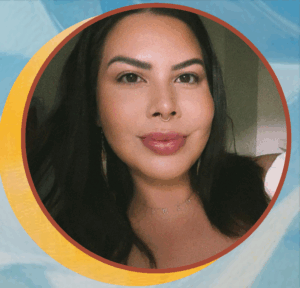
Callyn Wagner
“We are in a behavioral health desert,” Wagner said. “If someone is in crisis, there’s almost nowhere for them to turn. I want to learn the skills to help people so I can create a safer place for my babies, for my family, for all of us.”
Now a senior studying Social Work, Wagner entered Heritage with a vision: to become one of those culturally grounded, homegrown professionals her community so urgently needs. Her journey from EMT to stay-at-home mom to domestic violence victims advocate, community organizer, and cultural advocate has been shaped by personal tragedy, resilience and an unshakable belief that healing begins with culture.
FROM EMERGENCY RESPONSE TO HEALING WORK
Wagner’s commitment to behavioral health has roots in her own family’s tragedy. When she was just 15, her older brother died by suicide. In the painful aftermath, her family sought help but struggled to find support that truly met their needs.
“We were connected with non-Native counselors, and it felt like we were counseling them about our culture instead of getting support,” Wagner recalled. “We need counselors who come from similar backgrounds, have similar life experiences, who understand our ways.”
Years later, before she became a student, Wagner was raising her two children and volunteering wherever she saw a gap. She served with the local EMT team, responding to emergencies that ranged from car accidents to postpartum psychosis. One incident in particular became a turning point. She was dispatched to help a woman in the midst of a mental health crisis.
“She was suffering greatly, and I kept thinking, There has to be something better than this,” Wagner remembered. “Her experience really stuck with me.”
Both her family’s loss and her experiences in the field deepened her conviction to help others at their most vulnerable. “I realized my passion was being that person others can lean on. I don’t want anyone to feel the way my family did—like nothing would ever get better.”
STEPPING INTO ADVOCACY
In 2022, Wagner attended an informational meeting about Heritage’s Behavioral Health Certification Program, which was being offered online and on the Toppenish campus. The credit- bearing, non-degree program trains people working with tribal communities to provide culturally responsive, holistic behavioral healthcare, especially in rural areas where access is limited. She didn’t have any preconceived notions about the program or even thoughts about going back to school.
“I thought this might be information that would interest someone,” she said.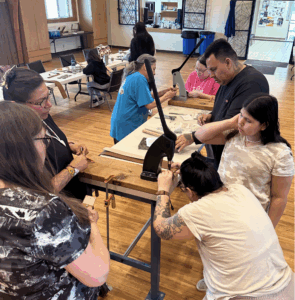
It turned out that someone was her. Wagner quickly signed up and started classes part-time at the first opportunity. By 2023, she was all in, pursuing the certificate as well as a bachelor’s degree. At the same time, she began working as a domestic violence and sexual assault victim advocate on her reservation.
It was not an easy role. She had no personal experience with domestic violence and came from a stable two-parent household. “But I saw the need,” Wagner said. “The women I worked with had often been assaulted multiple times, sometimes starting in childhood.”
Her passion for serving women in her community led her to become certified to represent them in tribal court. She sat through forensic interviews with children. She took on unpaid tasks because, in rural communities, waiting for outside professionals often means waiting too long.
“I figure if I get trained, I can provide what is needed right here,” she explained.
RECLAIMING CEREMONY
The more Wagner searched for ways to help the women she worked with, the more she came to believe that healing began with a connection to culture.
“I realized we needed a cultural way of talking about our bodies—about how they are sacred, life-giving and deserving of respect.”
Wagner’s advocacy work is intertwined with her commitment to cultural revitalization. She saw that many young women she worked with in her community lacked guidance at critical moments, such as when they began menstruating.
“Our ancestors knew what they were doing,” she said. “There are seven ceremonies (in the Dakota way of life), and they include a naming ceremony. But many of us never had that first step. I realized that for us to heal, we need to go back to our roots.”
Wagner had a vision of what she wanted to do, but she didn’t have a clear path to lead the way. With her culture based on the oral tradition, learning about what to do wasn’t as easy as opening a book or asking Google. Instead, she reached out to elders who carry traditional knowledge. One in particular, Sylvia Longknife, was especially helpful. Not only had she hosted coming-of-age ceremonies for women in her community, but she also works in behavioral health at the Indian Health Center in Wolf Point.
With the elders’ guidance, Wagner began a plan to revive coming-of-age ceremonies for young women. These ceremonies, she explained, teach not only about womanhood but also about the responsibilities and sacredness of bringing life into the world.
“We teach them to respect their bodies, to understand what healthy love looks like, and to know their worth as life-givers and sustainers.”
The more she learned, the more she understood that ceremonies, like life, are not something to rush into. To do them right, there is an order to things, there are steps that must take place, and preparations that need to be made long before each ceremony. She points to the creation of a woman’s belt as an example.
“In our tradition, the belt represents the tools and sustenance needed to enter adulthood—food, medicine, cloth, and a knife. Wearing the belt in the ceremony shows you now have the knowledge needed and are now a woman,” she explained.
This summer, she helped a handful of women complete this preparatory task when she attended a belt-making workshop organized by her father, Terrance Gourneau, and taught by a family friend, Issac Miller. This first step is just one of many that will be undertaken as the women she works with make their preparation. Wagner is hopeful that by next summer, some of the young women will be ready to start their first ceremony.
LOOKING FORWARD
As Wagner approaches graduation, her vision is clear. She wants to strengthen behavioral health services on the reservation, build culturally relevant programming, and ensure that future generations do not face the same gaps she witnessed.
“It has to be more than just me—it’s a collective thing,” she said. “I love my community, and I want it to be safe for my babies, for my family, and for everybody to have a shot at healing. If I can be even a little mustard seed in someone’s healing journey, then I’ve done what I’m supposed to do.” 
