
The Plight of the Yakamas’ Sacred Fruit – Wings Spring 2026

Elaine Harvey has gathered huckleberries her whole life. But a few years ago, her experience with them began to change. They seemed smaller and less plentiful.
Then one day, Harvey, a member of the Kamíłpa Band of the Yakama Nation, was washing her just- picked berries when she spied a tiny flesh-colored larvae amid the fruit. She didn’t know it at the time, but what she saw was a spotted wing drosophila, a fruit fly native to Southeast Asia, first seen in California in 2008. Harvey, who holds a Ph.D. in Natural Resources and Conservation, knew the worm might be the cause of the change in huckleberries she and others had been observing.
For years, Harvey worked to get government agencies to study the troubling situation — to no avail.
Then, in 2024, a connection she had to Heritage University led to action, ultimately resulting in the creation of a research project undertaken last summer by Heritage environmental science majors — all Yakama.
What the students documented in 10 weeks of research may ultimately signal the end of the spotted wing drosophila’s presence in the traditional huckleberry fields of the Yakama people.
FROM WORRY TO ACTION
The change in the huckleberry is troubling to many Yakama people. It’s a sacred ‘first food,’ a huge part of native life and cultural identity.
The “spotted wing,” as project participants would come to refer to it, lays its eggs inside berries as they ripen. The larvae feed on the fruit, causing berries to soften and rot. Like all invasive species, they quickly infiltrate their host plants, ultimately destroying ecosystems.
Harvey knew what the huckleberry might be up against, and in early 2024, a chance meeting with Jessica Black, Ph.D., director of Heritage’s Center for Indigenous Health, Culture & the Environment, revived conversations they’d had about steps that might be taken to protect the important fruit.
Harvey had worked for Yakama Nation Fisheries and Wildlife for several years, and Heritage had a longstanding relationship with the tribe, and both women were ready to ask the tribe for its attention and support.
“At that moment at the Center, we had everything in place — funding, the ability to help with leadership for the project, equipment, and relationships. The timing was right to try to get something done.”
After months of meetings, the Tribal Council passed a resolution in support of the research on Yakama land and assigned Cyrus Dick, invasive species coordinator with Yakama Nation Wildlife, as the lead research scientist and mentor for the Heritage students.
The work on behalf of the Yakama people would be led by the Yakama Nation and executed by Heritage students of the Yakama tribe.
THE DAILY WORK OF RESEARCH
By June 2025, it was time for the student researchers to come on board. Ilene Goudy, Kyal Shoulderblade, James Williams, and Virginia Yelechchin, along with another student — Corey Edgar from Northwest Indian College — joined the team. Each brought their own experience and personal reasons for wanting to take part.
“When I started picking huckleberries with my mom, I could barely walk,” said Williams. “Hearing about this work last year really struck a nerve back to my childhood. I had to jump at the opportunity.”
“I just had this deep feeling that I wanted to be part of this project,” said Goudy. “I want to learn how to advocate for first foods, whether it’s a fish or water or huckleberries or roots.”
As the students prepared to begin their work, Dick created maps, established collection methods, taught the students species identification methodology, and showed them how to use the spatial data collection app “Survey123.”
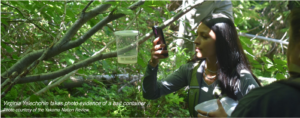
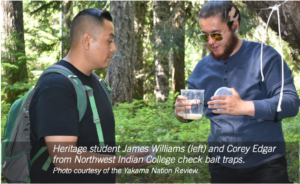
They created the bait — a mixture of yeast, sugar, and water. The students filled plastic sacks that would act as traps, then made their first of many three-hour drives to the closed area of the Yakama reservation.
Each week, they set 30 to 40 traps — almost 400 over the course of the summer. At least once a week, they checked each trap for the spotted wing.
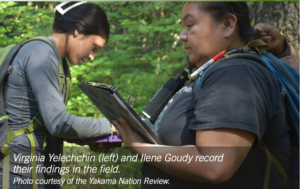
Upon their return to the Yakama Nation Wildlife office, students examined the contents of each sack, then moved whatever insect may have climbed inside to under a microscope for more accurate observation.
“The first two weeks, we didn’t find a single one,” said Williams. “Then the third week, we started seeing the results we were looking for.”
When they finally found one, Dick made sure the significance was noted.
“Cyrus said, ‘That’s never happened before — you are all part of history now,’” Williams said. “That was exciting.”
By summer’s end, 17 fruit flies had been found, for the first official documentation of the spotted wing drosophila on the Yakama Nation reservation and in the Gifford National Forest — identified by students.
INTEREST FROM POTENTIAL PARTNERS
Word on the findings has spread since then. “The National Forest Service, as well as other tribes, are very interested in what’s happening,” Black said. “I think there’s going to be a concerted effort over the next few years to get on top of this. “It could very well lead to a much larger effort in the Pacific Northwest.”
The Yakama Nation scientists and the Heritage students will present their research methods and findings to the Yakama Nation Tribal Council in the spring.
To everyone’s delight, the work will continue this summer. Black is working with Yakama Nation Wildlife scientists on research objectives, with Heritage providing two additional student research stipends for 2026.
NO HERBICIDES OR PESTICIDES
Since huckleberries are culturally sensitive, the tribe won’t use herbicides or insecticides to kill the spotted wing. “We have to find solutions outside of the ‘norm,’” Dick said. “One of those is ‘biocontrol,’ which means methods that utilize living organisms to reduce pest populations.”
Eradication methods might include fungi parasitoids, which are parasitic fungi that infect and kill their host, in this case the spotted wing. Another possibility is nematode bacteria viruses, which would be natural predators of the Drosophila.
Prescribed burns — where planned, intentionally lit fires are managed by experts under specific, safe weather conditions — could also be used. It’s a management effort that’s been used by indigenous peoples to manage huckleberry fields for thousands of years.
THE WORK CONTINUES
“The students dedicated a lot of work toward this project,” Dick said. “It’s important to them but also to our tribal members that we continue what they’ve done and not let it disappear. Infestations with invasive pests grow fast, so we need to keep going.”
“What we’re telling the elders is that there’s room for us to help you, to take a load off your plate,” said Shoulderblade. “The salmon, the deer, the plants all gave their lives to nourish us. I think doing research for us, by us, as Yakamas is super important.”
Dick said the work will continue to build on the pilot study conducted last summer as researchers explore additional collection and monitoring methods.
Dick would also like to see outreach to tribal members expand.
“We’ve sent emails and posted flyers at multiple sites with photos of the spotted wing and a note to ‘visit this website for more information or to report a sighting.’”
“The huckleberry becoming less plentiful is a day none of us want to see,” Dick said. “And we don’t want the students’ data to go idle or be forgotten.”
“Our role is to help train the next generation of natural resource managers and stewards,” said Black. “With strong partners like the Yakama Nation, that’s what we’ll continue to do.” 
Huckleberries: A Crossroad of Culture and Commerce
Aside from their cultural importance, huckleberries are also a sought-after agroforestry commodity. The small, intensely flavored fruit is in high demand for everything from pies and ice cream to syrups and jellies. In active seasons, more than 1,000 commercial harvesting permits are issued on Washington public lands, with buyers paying pickers $25–$30 per gallon. At specialty markets, prices can reach $40 per pound — reflecting both scarcity and the labor required to gather them by hand.
Huckleberries are one of several crops that fall under the agroforestry label, alongside wild mushrooms such as shiitakes and morels, floral greens, and medicinal plants. Harvested from forest ecosystems rather than cultivated fields, these non-timber forest products contribute tens of millions of dollars annually across the Pacific Northwest, with huckleberries representing a meaningful share.
That economic dimension underscores the importance of the Heritage University students’ research on multiple levels. Their documentation of spotted wing drosophila on Yakama lands is not only about protecting a sacred first food — it also safeguards a forest-based economic resource supporting harvesters, small businesses, and regional specialty markets.
The work has been supported by funding through several federal grants, including a USDA grant administered through Ecotrust.
“We are really pleased to support this important work for this key regional species, the huckleberry,” said Kara Briggs, vice president of Ecotrust’s Tribal Lands and Waters Stewardship program.
The investment reflects what the students’ findings make clear: preserving huckleberries strengthens cultural sovereignty, ecological stewardship, and Washington’s broader agroforestry economy.