
The President’s Address – Wings Fall 2025

Good morning, and please allow me to begin with my own family, because ours is the only story that I have fully earned the right to tell. My Papaw Carlton quit school in the first grade and spent his life plowing the fields that fed his family. He was the only brother of seven sisters, and it was not considered appropriate in those days for women to walk behind a mule and plow. By the time I was in first grade, I was reading the newspaper and legal documents to him, the written English language almost as much of a mystery to him as to some of the migrant workers in the Yakima Valley, whose children and grandchildren translate for them today. He died owning without debt 50 acres of farmland, a modest herd of cattle, a Massey Ferguson tractor, an old Chevrolet pickup truck, a well-worn green Plymouth Valiant car driven by my grandmother and later driven to college by me after her passing, and the little dog-trot house on the red clay hill on the Road to Damascus, Mississippi, where I spent the happiest days of my life as a young child.

Heritage faculty and staff carry the gonfalons representing the different programs during the procession of the Installation ceremony.
Little did I know that they would be the only carefree days of my life, carefree just long enough for me to come to understand adult responsibilities long before I was an adult in years. Papaw became so respected in that tiny hamlet without a traffic light, post office, or store that he was later selected to serve on the school board at the school in town, an especially poetic irony considering his earlier unselfish educational choice. My Mamaw Sarah, his beloved wife, ran the lunchroom at the school, cooking and serving thousands of school lunches with a smile, so it is no mystery why I remember her fried chicken and biscuits as the best I have ever tasted. Her retirement check was just over $100 a month. Of their three sons, my father, Charles, is the eldest. Struggling honorably with a debilitating illness that has stolen his mobility, but not his spirit, he joins us online today, along with my beloved sister back in Mississippi. They are not able to be here in person, but I love and salute them across miles and decades. My sister, Holly, sent me a beautiful pocket watch, a most appropriate gift to commemorate a moment in time.
And now I will try hard not to cry as I remember the person who, besides them and my David, would have most wanted to share this moment.
Some of you have heard me say that my mother, Peggy Carolyn Adams Gilmer, was born on the kitchen table of a sharecropper’s shack at the end of a cotton field and that my sister still has that table. My father’s family was slightly more prosperous, although very much part of the working poor, but my mother’s family was a product of multigenerational poverty. It is because my mother was pulling and filling a cotton sack from childhood on land her parents never owned, because as a child she lived through and overcame pretty much every kind of domestic abuse imaginable, successfully breaking the cycle of abuse with her own children, because she gave up her dream of a college education despite her natural brilliance so that my sister and I could be the first in our family to go to college, because she fought a long mental health battle with the demons of her childhood and finally won that battle in time to experience her grandchildren burden-free, because she read bedtime stories and the great works of literature to her children and grandchildren, because injustice in any form disgusted her and she reared her children to be advocates for equal rights, and because she and the rest of my family gave me the single greatest gift of my life—determination that I freely admit often transcends into stubbornness—I have the privilege of standing before you today as your fourth president, my heritage in so many unlikely ways not that different than the heritage of this essential university, America’s Essential University, and I would guess not that different than many of your own stories. If some in my family had not sacrificed all, and all had not sacrificed some, I would not be here. As the singer/songwriter Jewel reminds us: “I am the accumulation of the dreams of generations, and their stories live in me like holy water.” We are all the accumulation of the dreams of generations. Please raise your hand if you can say the same about your own family in any of the three languages. Look around at the sea of hands. I could stop here with my sermon preached, but those who know me know I will not stop quite yet.

From selling my blood plasma in college to buy gas for that old Plymouth to working multiple jobs in high school and college as a fry cook, grocery store bag boy, and later as a journalist because I wanted my beautiful sister to have the red dress in the dress shop window and my mother to have a simple ring with two small pearls and a few tiny sapphires, (her birthstone), from hearing the doctors tell us that my father would not live through the night as he lay in the hospital with Rocky Mountain Spotted Fever and driving home, still in high school, to borrow the money to pay for a funeral which thankfully was not needed since he fought his way back to life, I did what I was called like so many of our Heritage alumni and students to do, to slowly begin the cycle of lifting my family out of multigenerational poverty. I did what I had to do, and this is just some of it. It was not always pretty. I apologize to no one for it. I would do it again. Education was my constant, irreplaceable tool, and I dare say that this same stubbornness that preserved a family will serve Heritage University well in difficult moments when I will fight for us to keep climbing and never give into fading to oblivion.
Like my friend Ann just sang so beautifully, I did break my heart for every gain. To taste the sweet such as this moment, I have indeed faced the pain. Many of you, most of you probably, have broken your own hearts and faced your own pain, but like Celie says in Alice Walker’s Pulitzer Prize-winning novel, “The Color Purple,” “Dear God, I’m here.” So are you here, although I bet, like me, many of you are here despite someone who told you that you never would be. For me to earn the right to occupy this space, this one moment in time, and the moments we will have together in the coming years, I must be willing to fight with the last breath in my body, I must be willing to love with the last joy in my soul, those who have not yet found their own voices or who are still too afraid to use them. It is my job. It is my honor. It is my joy to be their champion.
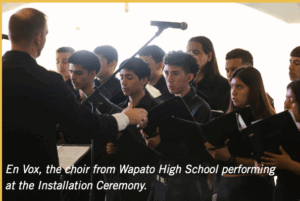
I have always been stubborn without apology because stubbornness allowed my family to survive, to have a roof over its head, food on its table, clothes on its back, and pride in its independence. I have never been truly hungry or homeless, but I have been days, maybe even hours, from each of these, the greatest fear not for myself, but that someone I loved and felt responsible for would be there with me. Have any of you ever felt that way? The question can remain rhetorical.
I do not know what it is like for the lands of my ancestors to be forcibly and illegally taken by people who looked a lot like me. I do not know what it is like for my ancestors to have been sold and owned as slaves by people who looked a lot like me. I do not know what it is like to be a parent or a child brutally separated from family and deported by people who look a lot like me. And I do not know what it is like to be a brilliant woman forced to pretend to be less than men, but my mother knew, again by people who looked a lot like me. I claim no experience not my own lived experience, but I do understand what it is like to be poor and smart, underestimated and filled with dreams. I know what it’s like to have holes in my shoes and to watch my beloved Granny cook a pot of soup or beans to eat all week long, listening to her singing her joy-filled song while preparing it. I know what it is like to carry a bucket of red tomatoes, the bucket almost as big as the boy carrying it, down a terrace row of ripe tomatoes that felt like it was half a mile long in the hot July sun, from the field to the house, and then to go back for another. I know what it is like to have to work harder as an LGBTQ+ leader in higher education, still one of few presidents, to gain the same position and respect that came easier to others. I know what it is like to have been an obese child and youth, ridiculed in my ill-fitting clothes, and yet still the person off of whose test papers the others wanted to cheat. I will not ask this time for a show of hands, but I suspect these and other lived experiences bind you to me and to each other. I do not compare in any way what I have overcome to what any of you still must overcome each day, some of your struggles so much greater than my own. I tell you truly and only that I empathize, and I am here for you.
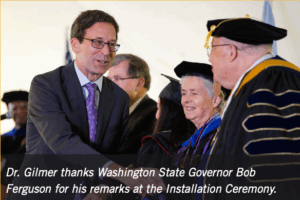
And lest this feel like a sad rather than a joyous moment, I remind us of the words of Nobel Laureate William Faulkner, who said: “I believe that man will not only endure, he will prevail.” I choose to believe he intended this prophecy to include all sexes and genders, races and orientations, and with respect to Faulkner, I suggest the defiant act of enduring, both individually and as a university family, is itself an act of prevailing. And for my part, I do it with no hint of self-pity and no desire for the pity of others, but with joy, with humility, with pride, and mostly with gratitude.
The future of Heritage University is indeed bright, a veritable temple of knowledge and wisdom willed into existence by two Yakama women, a Catholic sister, and others in the middle of a hops field. If they can defy those odds, my job is to ensure we defy any odds we face today and tomorrow. While we are each and all important, no one of us as a servant to the university is as important as the university itself and its mission. Surely, any university is always more important than its president. My dream is to build with you a future of financial independence, less reliance on state and federal funds, which means we must raise more money privately than we have ever raised. I cannot in good conscience ask anyone to support that which I do not support myself, so today, David and I announce that our personal fundraising goal will focus on the elimination of hunger on this campus. Yes, there are hungry people here, and hungry people cannot be expected to learn or to serve. Today I announce a presidential initiative to raise $1 million to provide no-cost meals to our students on campus and to anyone on campus who needs a hot meal. It will take a while to reach this goal, and while it is not a lot by the standards of some, because we are not wealthy people, we personally pledge $25,000 as the first donation.

This initiative is the first step in a proposal I will make to our board of directors to launch the largest capital campaign in our history to culminate in seven years with the 50th anniversary of our university, and more information on this dream is forthcoming. Money follows purpose. Our purpose is noble, and I am confident we will position our university for even greater financial strength and independence in its second 50 years. And for any who prefers to make an investment rather than a gift, I have commissioned an external, unbiased economic impact study, the first in our history, which reveals the annual contribution of Heritage University to the State of Washington is valued at approximately $300 million, generated by an annual operating budget of less than $30 million. There can be no reputable economist who would not call that an amazing return on investment.
We must also evaluate our excellent academic programs and ensure that they are fully aligned with the needs of the communities we serve, and if the recent success of our graduate programs is any indication, Heritage is already doing a great job of that alignment. We will explore the addition of workforce development programs tied specifically to the needs of local employers, including the fruit-based and other agricultural industries. While we will always remain the place-based, face-to-face, community-focused institution we were founded to be, we will carefully explore as the nation’s only private Native American Serving Non-tribal University and Hispanic Serving Institution what online and hybrid options we might develop to serve a much broader regional and national audience, increasing enrollment while protecting academic integrity and reinvesting the funds we generate through off-site programs into our community-based campuses and into our greatest resource—our people. This new initiative, named Heritage SOAR, Scalable Online Academic Resources, has the potential to bring considerable new revenue to the university and to bring it quickly if we can gain the buy-in of all campus stakeholders. And speaking of soaring, we even have the potential to launch the first aviation program at a Minority Serving Institution such as ours, although this dream is in the early stages.

There are more than 800 Minority Serving Institutions nationwide educating 20 percent of our nation’s students, and we are already exploring collaborations with them. We are preparing to fully launch the Dr. Kathleen Ross Institute for Student Success, named in honor of our beloved founding president and based on the ideals and pedagogy that she and many of you have proven here at Heritage in service to new majority and first-generation students. As far as I can tell, you are the experts, and why not be recognized and celebrated nationally as such? We will engage even more robustly with the communities we were founded to serve, such as the Confederated Bands and Tribes of the Yakama Nation, other tribal nations, and the Hispanic-Latino community, while preserving our commitment to serve everyone and to discriminate against no one. We will more fully reach out to and incorporate our proud alumni into our work, and we will continue to put our students forward as our best storytellers.
We will leave no valid and honorable pathway unexplored and see no obstacle standing in our way as a barrier, but rather simply as something to go over, through or around. This includes the challenging sociopolitical climate today, which affects all of higher education, but affects Heritage and our students much more deeply. I will stand with that student afraid in this moment to leave his, her, or their home to come to class, and I believe you will join me in continuing Heritage’s legacy as a safe place for all to come together, teach, and learn. We are strong now. We will be even stronger at age 50. We will together use the years of the presidency with which you honor me to ensure that the work of our founders was not in vain.
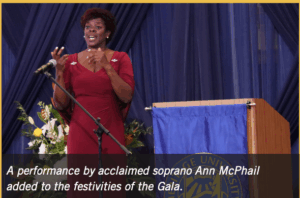
In closing, the prelude to this event was “I Wouldn’t Take Nothing for My Journey Now,” an old Southern gospel song from my childhood that best describes how I feel in this moment. It also best describes the 24 years I have walked this pathway with my spouse, David, who, better than anyone I know, exemplifies the scripture found in the Book of Ruth: “Whither thou goest, I will go. Thy people shall be my people.” Through the best and the worst of times, and there have been plenty of both, there has never been a day I felt unloved because the unselfish, all-consuming love David gives is powerful. I honor him today and wish to share this life’s journey so fully with no one else. I thank the friends and beloved family of choice who came so far to be here and who are participating from their homes. I thank the board of directors for the opportunity to serve, and with absolute humility, I thank the students, faculty, staff, administration, alumni, and friends of Heritage University for all that this moment implies. And I thank the inaugural committee, the transition committee, and every person who worked so hard to make these events possible.
I was smart, but I was not the smartest. Neither was I the richest or the most handsome, the strongest or the fastest, the kindest or the most ruthless, but I remind anyone here who might be struggling that I am not special and that I am living proof of just one thing: what can happen when you are simply the most determined. I remember my great-grandmother, Onie Hannah Adams, descended of the proud Choctaw people of Mississippi, and in her memory, I honor the lands and the ancestors of the Yakama people, and indeed, I honor all of your ancestors who I hope will join with mine to bind us as one family across space and time. I make myself vulnerable to you today with this story, not self-indulgently, because I have no need to tell it. In this lifetime, my ego has been fully satisfied. I have been more than I thought I would be, so instead I share my story in the hope that some strand will resonate with some strand of your own story, and across all the differences which we honor, we will find a sameness that unites us. Never has such unity been needed more than now. 
